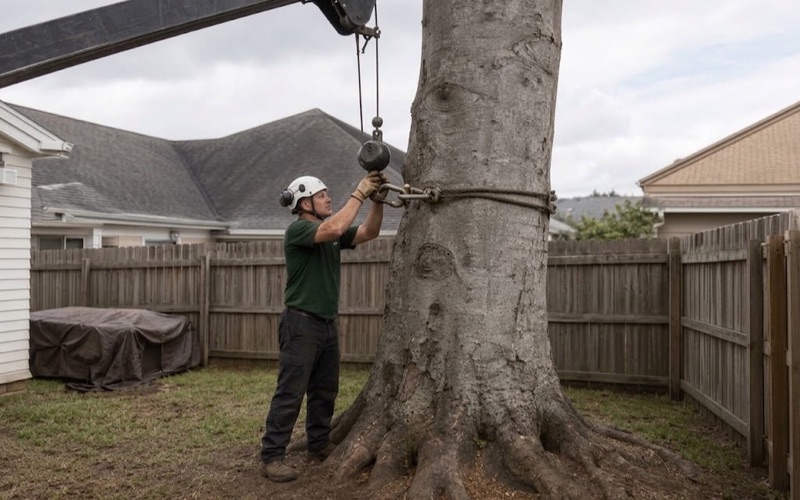
Spring Hill Tree Removal has been taking trees down in White Bluff for more than twenty years, and tree removal here begins with a question about the ground rather than the crown. The trunk tells us how the tree grew, but the first three feet of soil under it tell us how it is going to come down. On this ground the second answer is the one that sets the plan.
That matters to a price, because what fails a tree in this town is the soil more often than the wood. Estimates are free, the scope goes in writing before a saw runs, and we will tell you when a tree can be cabled, braced or pruned instead of removed.
What follows is how we read a tree in this town and what the ground under it does through a wet winter. It also covers what a stump grind costs here and why, and which rules a homeowner or a builder runs into before a tree comes out.
The Ground Under White Bluff Is a Pan, Not Bedrock
An intersect query run against the EPA’s own Level IV ecoregion polygon service puts a point at the town center inside ecoregion 71f, the Western Highland Rim, within Level III ecoregion 71, the Interior Plateau. The town sits at 833 feet. The Rim’s geologic base is limestone, chert and shale of Mississippian age, and what lies over it is solution residuum rather than rock anywhere near the surface.
Soils across the Rim run cherty, acid and low in fertility, mostly Paleudults and Fragiudults. Two of the common series do most of the work in a tree quote here, and they do opposite jobs: one governs how a tree stands up, the other what it costs to grind the stump out afterward.
Tennessee’s State Soil Was Named for This County
The Dickson series is the official state soil of Tennessee. It was established in 1923 in Dickson County and first mapped in the Soil Survey of Dickson County published in 1926, and the state soil survey staff selected it for the sheer acreage of it mapped across Tennessee. The reference soil for the whole state is the soil named for the county this town sits in.
A Dickson soil is a fine-silty Glossic Fragiudult formed in a silty mantle two to four feet thick over limestone residuum, on the undulating upland ridges of the Highland Rim. It is moderately well drained, and its native forest is oaks, yellow-poplar, hickories, gums and maples. All of that reads as ordinary until you reach the layer in the middle of it.
A Pan at 18 Inches, With Rock More Than Five Feet Down
The defining feature of the series is a fragipan: a firm, brittle layer 18 to 36 inches below the surface, with slow to very slow permeability through the pan and moderate permeability above it. Depth to bedrock is greater than five feet. Roots stop at the pan even though rock is nowhere near them.
That one fact reshapes every mature tree in town below grade. Rather than the deep anchoring roots the same species would put down in deeper soil, a White Bluff tree spreads a wide, shallow plate that rides on top of the pan. We assume that plate on every job in this town and confirm it at the base of the trunk before planning a fell.
Looking for tree-removal closer to Thompson’s Station? See Tree-Removal in Thompson’s Station.
Why Trees Here Tip Whole Instead of Snapping
The pan is not only a rooting limit; it is the local windthrow mechanism. A tree that cannot root past 18 to 36 inches builds a wide, shallow plate, and because water moves slowly through the pan, that plate sits in perched water through a wet winter. Saturated ground holds a root plate far less firmly than drained ground does.
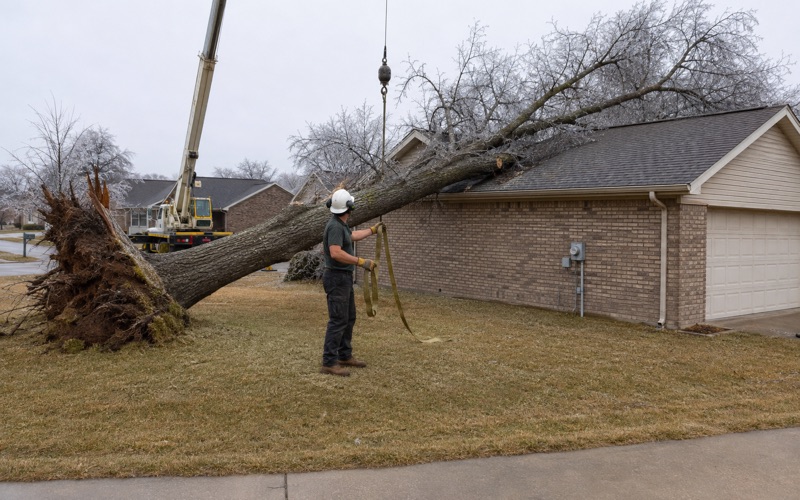
Load that tree and the failure goes to the weakest link, which here is the soil rather than the wood. Under an ice load or a wind gust the whole plate lifts and the tree goes over intact, instead of the stem snapping partway up. Homeowners who have only seen broken tops are often surprised by what comes down here.
Ice is the load case that matters here. The National Weather Service Nashville office recorded a major winter storm beginning January 26, 2026 that brought heavy ice across Middle Tennessee, with accumulations of half an inch or more crippling the Nashville metro area. White Bluff sits in that office’s county-wide forecast zone, TNZ025, Dickson, on ground that takes roughly 50 to 56 inches of precipitation a year.
Reading the Root Plate Before the Cut
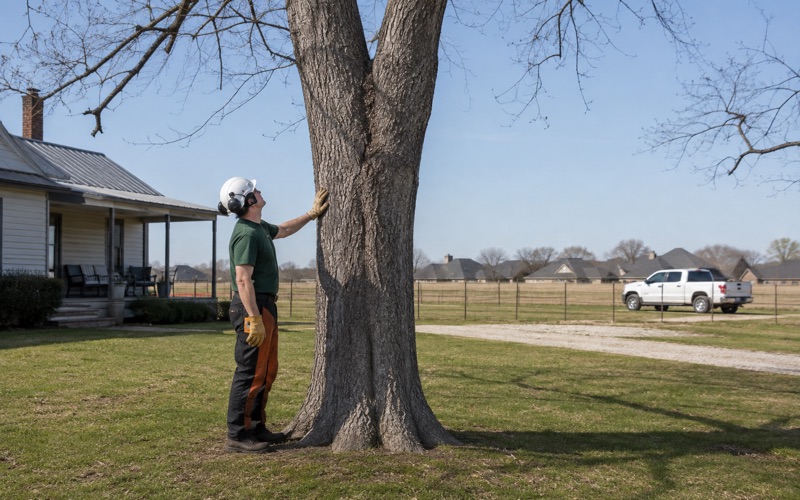
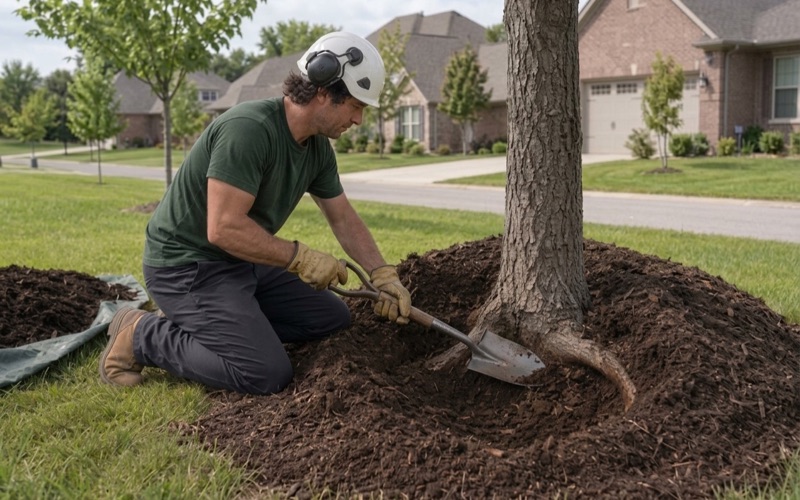
We start at the root flare rather than at eye level. Soil cracked or heaved on one side of the trunk, a flare that vanishes into a mound instead of widening into the ground, and a lean that has grown since the last storm all say the plate has moved. Where the flare is buried we use an air spade for a root collar excavation, because a girdling root or a rotten collar is invisible under four inches of mulch.
Above that we take diameter at breast height for the record, then look for the defects that decide whether a tree is a removal or a repair: co-dominant stems with included bark, a conk at the base, deadwood through the crown. When the answer is a repair, cabling and bracing or a crown cleaning is the better job and we say so. The finding goes into a written tree condition report you can hand to a neighbor, an insurer or a review committee.
Taking Down a Tree That Wants to Lift
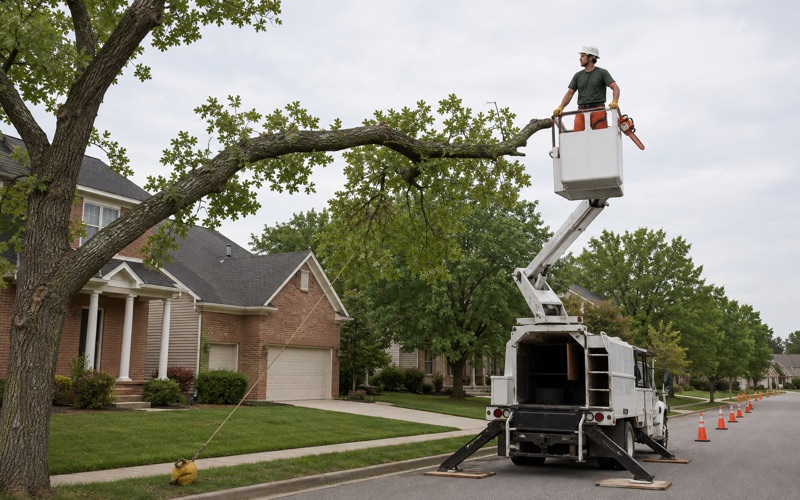
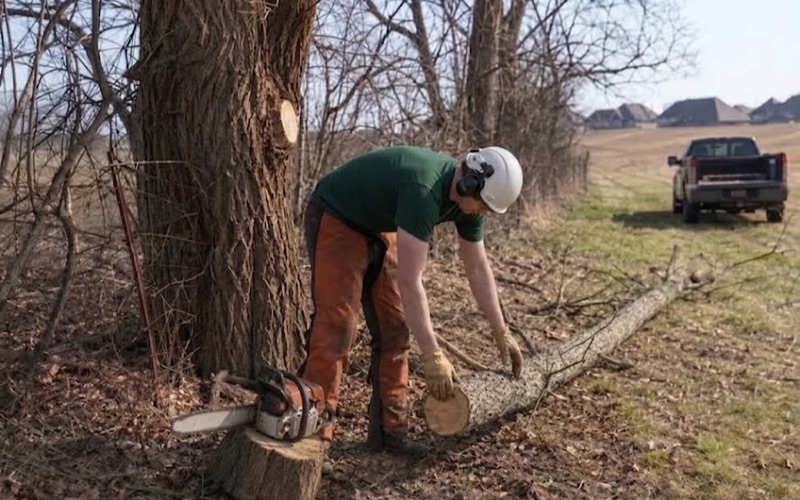
A tree standing on a saturated plate can move before the back cut is finished, so the rigging plan comes before the saw plan. We set a bull rope through a rigging block and lower pieces on a friction device instead of dropping them, keep every load inside the working load limit of the weakest component, and work to the ANSI Z133 safety requirements. Where the job is pruning, we work to the objectives and cut types the ANSI A300 pruning standard defines.
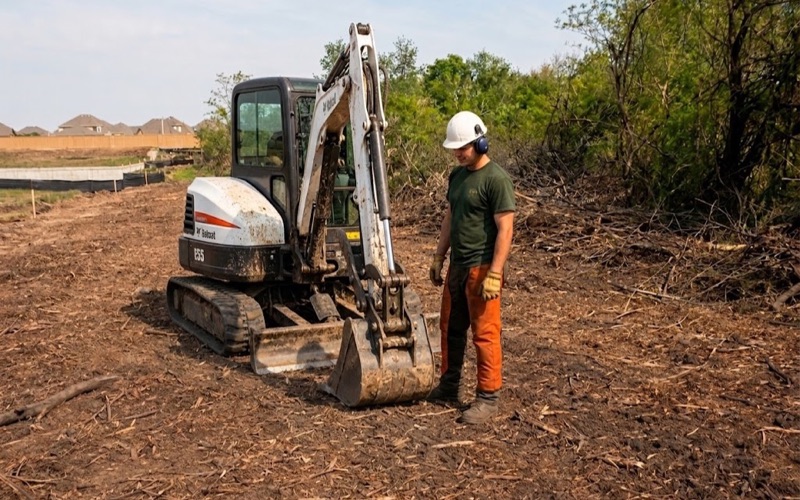
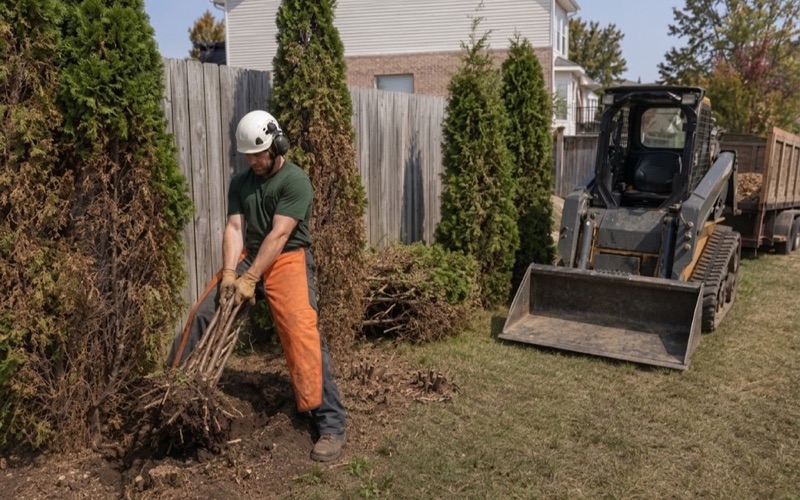
Access here is usually a yard rather than a job site. Compact tracked equipment fits through a back-yard gate, which keeps an ordinary tree from becoming a much bigger operation and leaves the lawn under it intact.
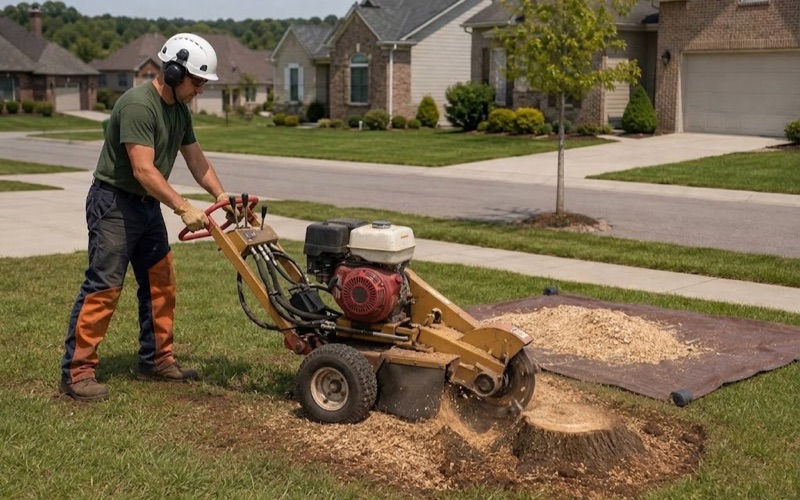
Chert, Not Limestone: What It Costs to Grind a Stump Here
The Bodine series is the other name that shows up in a quote in this town. It is a loamy-skeletal, siliceous Typic Paleudult formed in residuum weathered from cherty limestone, somewhat excessively drained, on slopes of 5 to 70 percent, with depth to cherty bedrock greater than five feet.
What matters on a grind is what is packed into it. Bodine horizons carry 20 to 85 percent rock fragments, and the particle-size control section averages 35 to 80 percent rock fragments, primarily chert gravel, cobbles and stones. That is a stump standing in gravel.
Chert Dulls Teeth Instead of Stopping the Machine
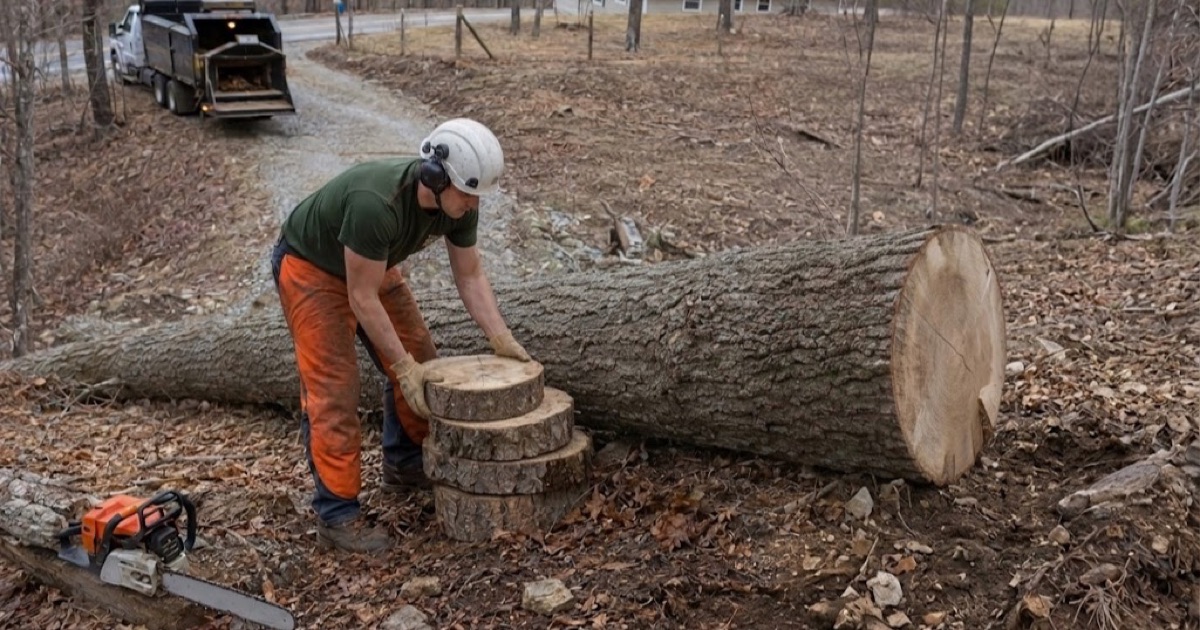
Bedrock is not the obstacle on this ground, because it is more than five feet away. Chert is the obstacle, and it behaves differently: it will not stop a tracked stump grinder the way a solid ledge does, it wears the teeth off it. A grind that runs on one set of teeth in clean silt can go through several here.
That is a cost rather than a surprise, so it belongs in the quote and not in a change order afterward. We say up front how deep the grind goes, whether the grindings stay on site or leave with us, and where the trunk rounds and the chips end up.
Wooded Bodine soils carry chestnut oak, post oak, blackjack oak, white oak, hickory, maple, beech, eastern redcedar and Virginia pine, with white oak abundant on the broader uplands. Species is not trivia on a removal: it tells us the density of the wood we are cutting and the weight of every piece before it leaves the tree.
What the Town Asks, and Where the Load Goes
The Rules That Reach a Tree Here
We found no tree removal permit for a tree on private residential property in any White Bluff source we read, and no tree board or urban forestry program either. That absence is worth stating carefully, because it was recorded against a working control: the same document host returned the full text of the Zoning Ordinance’s Article III and of the Design Review Manual’s sections 2.3, 2.5 and 2.6, tree standards included, so retrieval was working when the permit article failed to appear. What we read is the zoning ordinance and the design review manual, not every title of the municipal code.
None of that means the town is silent on trees. A corner lot carries a sight triangle: within the area formed by the center lines of the intersecting streets or railroads and a line joining points on them 75 feet from the intersection, nothing may obstruct vision between three and a half feet and ten feet above the average grade. Section 3.080 of the 1990 zoning ordinance is what turns a low limb at an intersection into a crown raising rather than a matter of taste.
Development work meets more than that. Under the Design Review Manual adopted in 2008, every tree of at least four inches in caliper removed during or before site development must be replaced where there is land for it, at a minimum of 1.5 inches in caliper for canopy trees and one inch for understory trees. The manual asks for windfirmness by name as well, directing that bands of trees such as fencerows, which would not stand as wind-firm individuals, be kept as an effective screen and wind buffer.
Licensing in Tennessee, Said Plainly
Tennessee issues no trade-specific tree care or arborist license, so anyone describing a state tree license is describing something that does not exist. What the state does require is the contractor license, which applies at $25,000 or more in materials and labor. The county-option Home Improvement law has been adopted in only a short list of Tennessee counties, and Dickson is not among them.
Where a Contractor’s Load Actually Goes
Dickson County runs a convenience center inside the town at 500 Industrial Drive, open Monday, Wednesday, Friday, Saturday and Sunday and closed Tuesday and Thursday. It accepts residential trash only and takes no business waste. A tree crew’s load is business waste, so the center in town is not our disposal route and no part of a contracted removal goes through it.
Commercial loads go to the county landfill instead, where the gate is open Monday through Friday from 7:00 a.m. to 3:30 p.m. and Saturday from 7:00 a.m. to noon. A job that runs late leaves a loaded truck sitting overnight, so on a large removal we plan the haul around the gate rather than around the saw work.
Lines are a separate question we settle before quoting. Dickson Electric System serves 36,000 customers across five counties, reports that vegetation and tree-related outages cause almost 80 percent of its power outages, and holds itself to clearance within a 15-foot radius of distribution lines. Storm debris on your own property is yours to remove, and you may hire a private contractor at your own expense for trimming that meets the utility’s specifications.
- 20+ Years in Middle Tennessee
- Free Estimates
- Written Scope Before Work Starts