Spring Hill Tree Removal has handled tree trimming and pruning in Spring Hill, TN for more than twenty years, serving surrounding cities including Thompson’s Station, Columbia, Franklin, Brentwood and Nolensville. Pruning is the part of this trade where the difference between a good crew and a cheap one is invisible for about three years and then obvious for the rest of the tree’s life.
Every pruning job we quote names an objective from the ANSI A300 standard and the cut types that go with it, written on the proposal before anyone climbs. That is not paperwork for its own sake. Cleaning, raising, reduction and thinning are four different jobs producing four different trees, and a quote that just says trim is a quote that has agreed on nothing.
We also price the alternative to removal when there is one. A co-dominant union with included bark, the defect that takes down more suburban shade trees here than any disease, can often be supported with cable or brace rods for well under the cost of taking the tree out and replacing it. On one hackberry in this market the comparison came out at roughly $2,500 to cable against $5,400 to remove.
Pruning to a Named A300 Objective
Crown Cleaning and Deadwooding
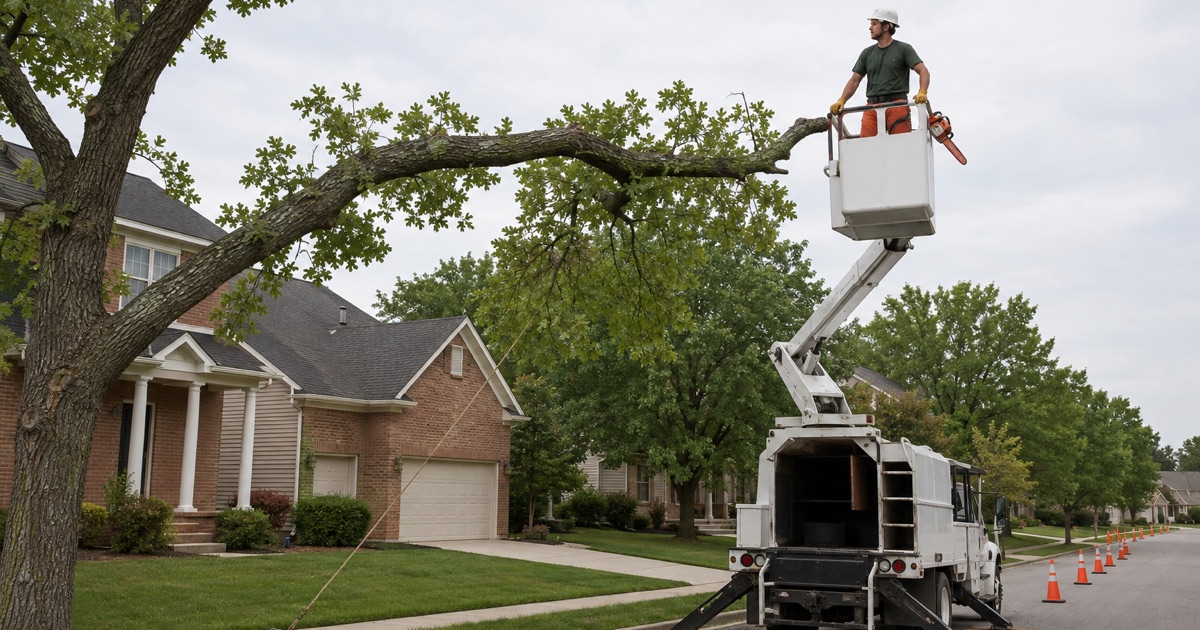
Cleaning removes dead, dying, diseased, broken and detached wood from the canopy, and it is the objective most often needed and least often specified. On a mature shade tree over a driveway or a patio, deadwooding is what stops a limb arriving unannounced on a still day. It changes the shape of the tree very little, which is precisely why homeowners undervalue it and why it is usually the first thing we recommend.
Crown Raising for Roofs, Drives and Sidewalks
Raising lifts the lower canopy to give clearance over a roof, a driveway, a walk or a lawn, and it is done by removing whole lower limbs back to the trunk rather than shortening every branch to a line. Done properly it keeps the crown balanced and the trunk taper intact. Done as a flat cut at the eave it leaves a lopsided tree that grows straight back into the roof, which is the version an insurance inspection tends to trigger and a careless contractor tends to supply.
Crown Reduction and Crown Thinning
Reduction shortens leaders and limbs back to live laterals big enough to take over as the new terminal, which is how a tree gets smaller without being topped. Thinning selectively removes interior branches to reduce density and wind loading while leaving the outline unchanged. They are different tools for different problems — reduction for a tree that has outgrown its space, thinning for one catching too much wind — and confusing them is how a crew ends up stripping the interior of a tree and calling it a reduction.
Cabling and Bracing Instead of Removal
Co-Dominant Stems and Included Bark
When two stems of similar size compete for the lead, bark gets trapped in the union between them instead of wood knitting together, and the joint has far less strength than it looks like it has. That is the defect behind most of the mature-tree failures we see after an ice event. It is also one of the few defects that supportable hardware genuinely addresses, provided it is found before the union has begun to move.
Dynamic Cabling Systems and Static Cable
A dynamic cabling system uses a synthetic rope with a shock-absorbing component installed high in the crown, allowing the stems to move and keep building reaction wood while limiting how far they can travel apart. Extra high strength steel cable is the static alternative where movement needs to be restrained more firmly. Which one suits a tree depends on the union, the species and how much the crown moves, and either is inspected periodically rather than installed and forgotten.
Brace Rods, and What Support Actually Costs
Where a union has begun to crack, threaded brace rods through the stems address the joint itself rather than limiting motion above it, and they are usually installed together with a cable. Installed prices in this market have run in the range of a few thousand dollars — one job broke down as roughly $3,600 in rods and $1,100 in cables — against removal-and-replacement costs that are frequently higher and always slower. We quote both honestly and let the owner weigh them.
Timing, Species and What We Will Not Do
Why We Do Not Top Trees
Topping cuts leaders back to stubs with no regard for a lateral to take over, which removes the foliage the tree lives on and forces a mass of weakly attached shoots at every wound. Those shoots are the limbs that fail in the next ice load. Murfreesboro and Mount Pleasant both prohibit topping by ordinance — Mount Pleasant with one narrow exception for pruning Callery pear against wind damage — so in part of our service area it is unlawful as well as bad practice.
Species That Need Structural Work Early
Callery and Bradford pear were planted through this metro’s subdivisions and share a single flaw: crowded, included-bark unions that split under ice and take half the canopy with them. Leyland cypress, planted as a fast screen, browns out from the interior once the rows close in. Both are far cheaper to manage with structural pruning while young than to deal with after a failure, and on the newer streets here most of those trees are still young enough for it.
Pruning After Ice and Wind Damage
A storm-damaged tree is pruned differently from a healthy one. Torn wood is cut back to sound tissue with a proper collar cut rather than left ragged, hangers are removed rather than knocked down, and any union that has moved gets inspected before the crew works above it. After the January 2026 ice event we saw a great deal of cheap restoration work that amounted to topping under another name, and those trees are now the ones needing removal.
Pruning Around Buildings, Drives and Power Lines
Clearance Over a Roof and an Insurance Inspection
Carriers have grown far more assertive about limbs touching or overhanging a roof, and a non-renewal on that ground makes finding another policy harder. The fix is a raise or a reduction that puts real, lasting clearance over the roof plane while leaving the tree structurally sound. We document the objective and the work so there is something to send back to an underwriter.
Right-of-Way Clearance and Who Owns the Line
Three electric providers serve parts of this city, and which one holds the line at your address is settled by your electric bill rather than by the street you live on. Utility crews clear their own right of way — Middle Tennessee Electric maintains 20 feet on each side of a line — and that work is theirs, not ours. Our part is the tree on your side of that corridor, and the service drop from the pole to the house, which we will not touch until the utility has dealt with it.
Rigging Over a Target Instead of Free-Felling
Where limbs sit above a roof, a pool, a fence or a bed, they come down on rope. A rigging block, a bull rope and a friction lowering device let a piece be lifted clear and lowered under control rather than dropped, with every component chosen against its working load limit for the weight being moved. It is slower than free-felling and it is the reason a pruning job over a conservatory finishes without a repair bill attached.
- 20+ Years in Middle Tennessee
- Free Estimates
- Written Scope Before Work Starts