Spring Hill Tree Removal provides tree disease treatment and plant health care in Spring Hill, TN, serving surrounding cities including Thompson’s Station, Columbia, Franklin, Brentwood and Nolensville. Twenty years of working the same ground has taught us that most calls about a sick tree are not about a disease at all. They are about roots, soil and something done to the tree years before anyone noticed.
That matters especially here. Nearly every lot in this city was graded and built after 1990, which means the trees standing on them either survived construction or were planted into the fill left behind by it. Compaction, altered grade and a buried root flare are the three most common findings on a declining suburban tree in this market, and none of them is a pathogen.
So we diagnose before we recommend anything. That means looking at the crown, the trunk and the flare together, asking what the site has done to the tree, and only then deciding whether the answer is a treatment, a soil correction, a pruning objective or a removal.
Diagnosis Before Treatment
Reading the Crown, the Trunk and the Flare Together
A thinning crown is a symptom with a dozen possible causes, so it is read alongside everything below it. Dieback starting at the top and working down suggests a root or vascular problem; dieback on one side suggests something local, such as a girdling root, a trunk wound or a severed root on that side. We note where the decline started, which is usually a better clue than how bad it currently looks, and we ask what changed on the site in the last few years.
Root Collar Excavation and What Is Buried
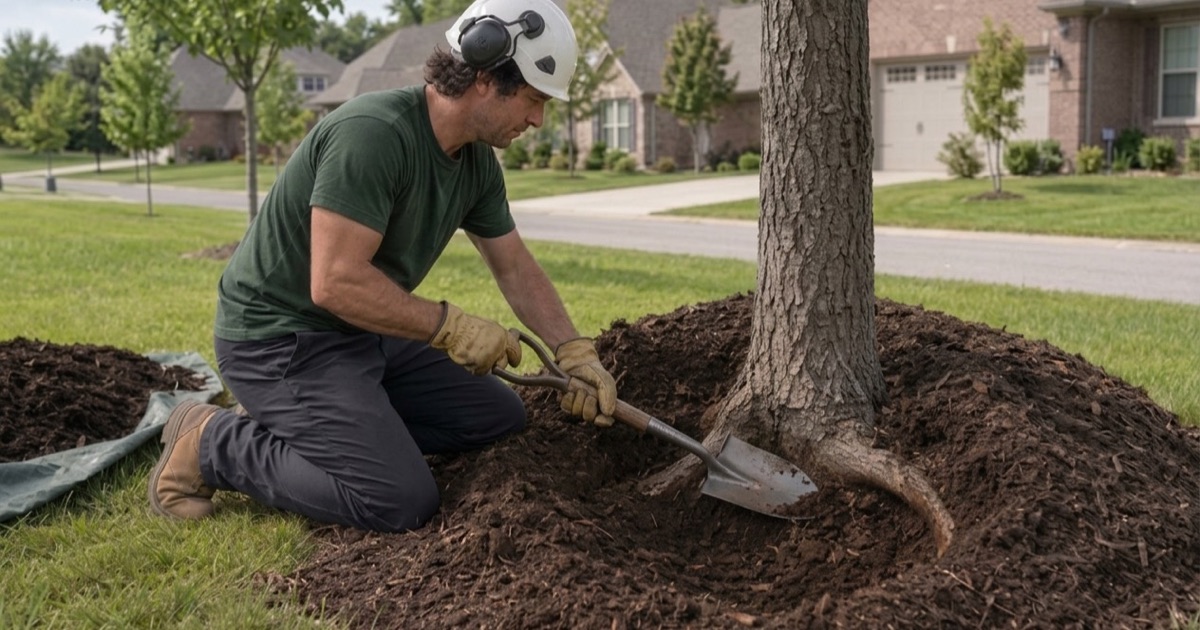
When the crown offers no explanation, the answer is normally under the soil. An air spade lifts mulch and fill off the root collar without cutting roots, which exposes girdling roots wrapped around the stem, decay hidden at the flare, and trees planted several inches too deep. On the newer streets here this is the single most productive thing we do, because a builder-planted tree set low and then mulched over for two decades is common enough to be a pattern rather than an exception.
When the Problem Is the Site, Not a Pathogen
Slow-draining clayey residuum, a root zone compacted by construction traffic, fill spread over original grade and irrigation set for turf rather than trees will all put a tree into decline with nothing infectious involved. Those are correctable, and they are correctable without chemicals. A treatment program applied on top of an uncorrected site problem is money spent against the wrong cause, and we would rather say so than sell it.
What We Actually See on These Properties
Emerald Ash Borer and Standing Dead Ash
Emerald ash borer kills the cambium beneath the bark, and the practical consequence is a safety one: a dead ash loses limb strength quickly and becomes unsafe to climb well before it looks hazardous from the driveway. Those trees come down from a lift or a crane rather than by a climber working the canopy. Treatment is a long-term commitment that works on healthy trees caught early, and Tennessee repealed its emerald ash borer quarantine in 2021, so nothing restricts moving the wood once a tree is down.
Decay Fungi, Conks and Cavities
A conk is a fruiting body, which means the decay behind it has been at work for a long while already. Where it appears determines how seriously to take it: at the root flare or on a buttress root it sits exactly where the tree carries its load into the ground, while the same fungus high in a limb is a pruning question. We sound and probe the flare, record what we find in writing, and judge the tree against what stands under it rather than issuing a verdict on the fungus alone.
Callery Pear, Leyland Cypress and Planting Mistakes
Some of what we are called to is not disease but a species planted into a situation it cannot hold. Callery and Bradford pear fail at crowded, included-bark unions under ice, and structural pruning while the tree is young is the only treatment that helps. Leyland cypress planted as a screen at close spacing browns out from the interior once the rows close and canker follows into the stressed stems, and no conifer refills bare interior wood. Naming those early saves an owner from paying for treatment that cannot work.
Plant Health Care That Actually Changes Something
Soil Decompaction and Radial Trenching
Where a root zone has been compacted, air and water cannot reach the roots regardless of how much is poured on. An air spade fractures compacted soil without shredding roots, and radial trenching cuts spokes out from the trunk that are backfilled with amended material so roots have somewhere to go. On a tree declining in construction fill this does more than any product, and the response shows in the following season’s extension growth.
Pruning as a Health Treatment
Crown cleaning to remove dead, diseased and broken wood reduces the inoculum in a tree and takes weight off compromised limbs, and it is a treatment rather than cosmetics. Thinning can help a crown that is holding moisture and catching wind. What does not help is removing large amounts of live foliage from a stressed tree, which is why heavy reduction on a declining specimen is the wrong instinct and topping is worse than doing nothing at all.
Mulch, Water and the Boring Answers
Most trees on these lots would improve from three unglamorous changes: mulch pulled back off the trunk and spread as a wide shallow ring instead of a volcano, irrigation adjusted so the root zone is watered deeply and occasionally rather than lightly and daily, and equipment kept off the root zone. None of that is billable at any scale, and we tell owners about it anyway, because a report that only recommends work we sell is not worth what was paid for it.
When Removal Is the Honest Recommendation
Sometimes the answer is that the tree is finished. Extensive decay at the root collar, a failed union already moving, a dead ash over a driveway or a screen row that has lost its interior are all cases where treatment buys nothing but time and the risk keeps increasing. We would rather lose a treatment sale and keep the relationship than take money for a program on a tree we expect to be removing in two years.
- 20+ Years in Middle Tennessee
- Free Estimates
- Written Scope Before Work Starts