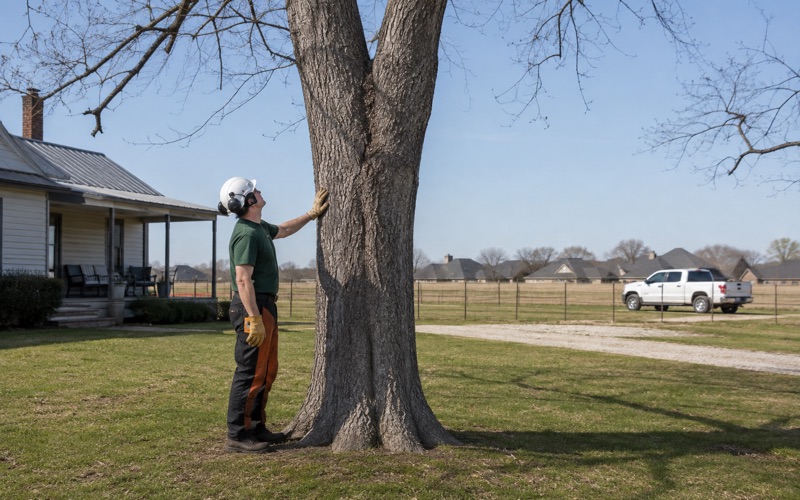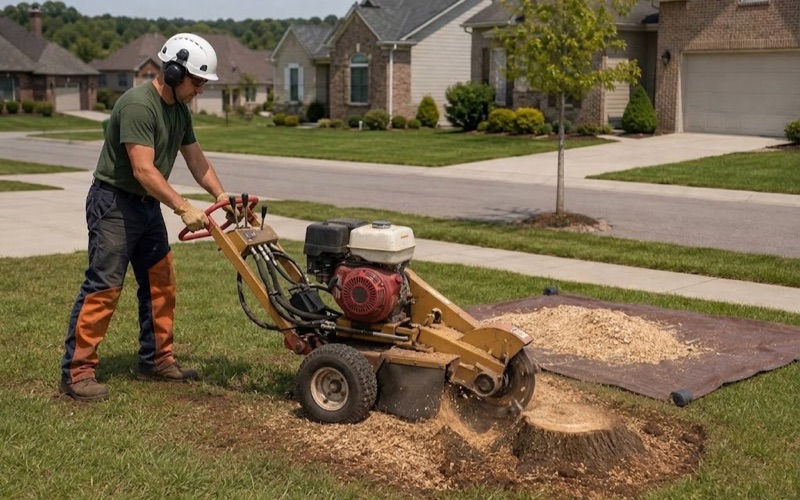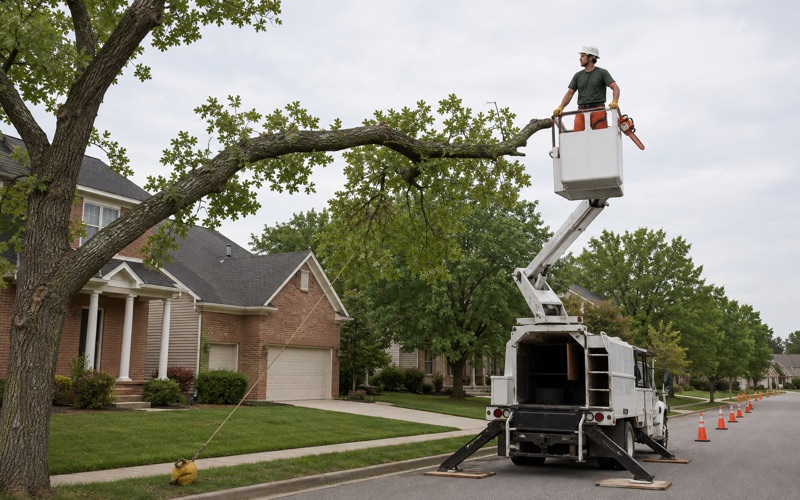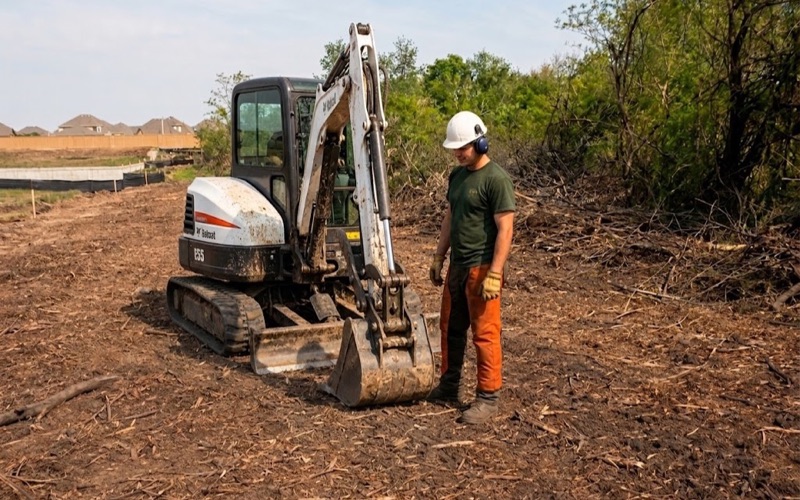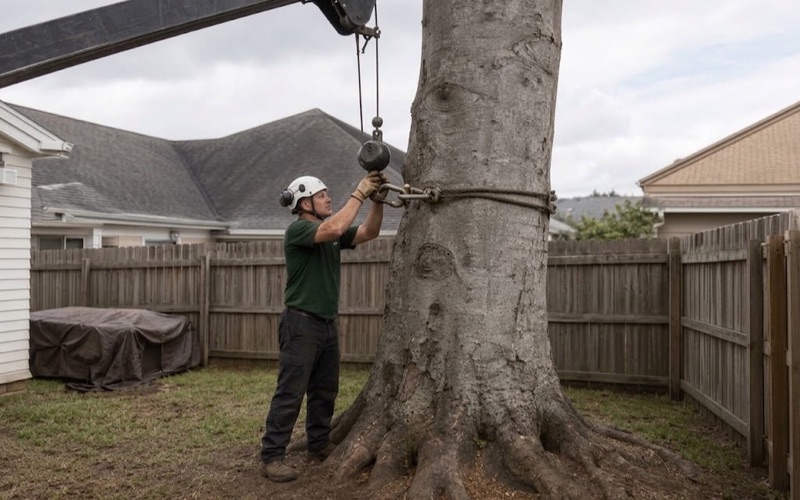
Spring Hill Tree Removal has handled tree removal in Thompson’s Station for more than twenty years, and on this ground the first thing we look at is never the tree. It is the lot underneath it.
The town keeps its tree rules inside the Land Development Ordinance, the single unified code adopted out of its 2015-2016 planning process, rather than in a standalone tree ordinance. Section 3.3.14 decides what applies to a property by lot type, platted or developing, residential or not, above or below one acre, before anyone measures a trunk. Two houses on the same street can sit under different requirements for that reason alone.
So we read the applicability table for the address first and quote the work second. That tells a homeowner whether a Tree Removal Permit from the Department of Community Development is in play, whether anything has to be retained or replanted afterward, and what the removal will actually involve, before a saw comes off the truck rather than after.
Your Lot Decides the Rules Before the Tree Does
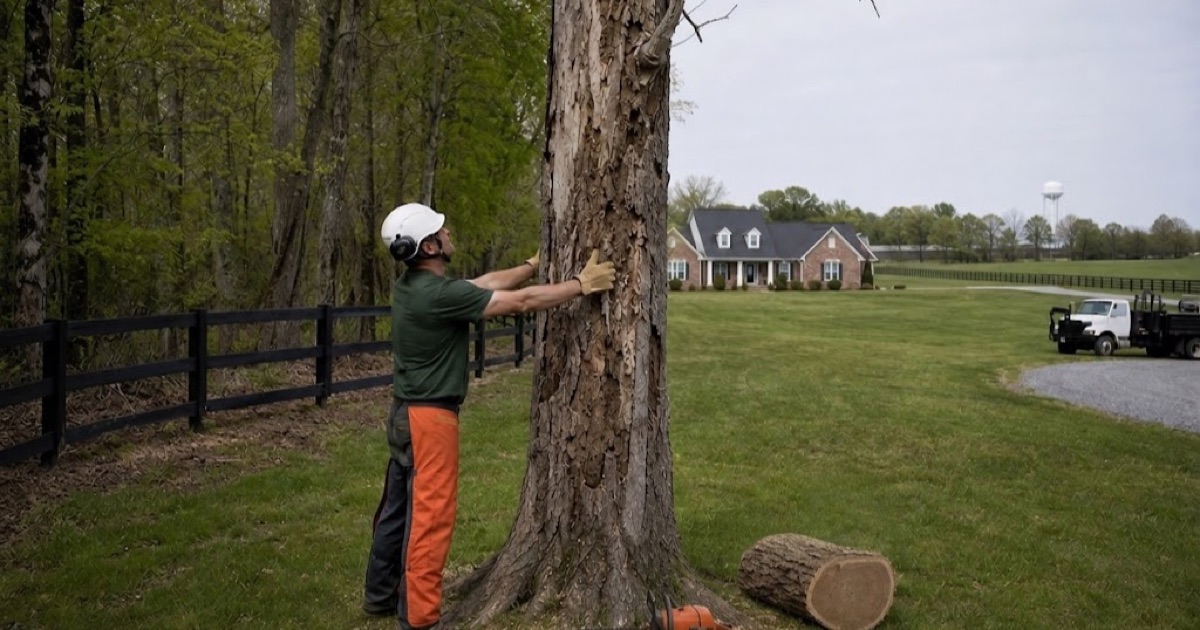
Section 3.3.14 carries three separate standard sets: tree canopy retention, tree removal on existing lots, and specimen tree protection. Table 3-1 assigns them by lot type, and the assignments are not uniform across the town. Reading that table correctly is most of the answer to what a job here involves.
The One-Acre Line in Table 3-1
A platted residential lot of one acre or less, with or without an existing use on it, is subject to none of the three sets. Not canopy retention, not the tree removal standards for existing lots, not specimen tree protection. That single row is why a great deal of residential work in this town is simpler than the length of the ordinance suggests.
Above the line the answer changes. A platted residential lot larger than one acre is subject to the tree removal standards for existing lots and to specimen tree protection. The ordinance adds that a Tree Protection Zone is not established on those lots, and that the standards are not applied to lots containing detached residential uses smaller than an acre.
Nonresidential Ground and Land Under Development
A vacant nonresidential lot of any size picks up canopy retention and specimen tree protection. A nonresidential lot of any size that already carries an established use is subject to specimen tree protection only. Residential or nonresidential land that is actively being developed carries canopy retention and specimen tree protection together.
Housing here is overwhelmingly detached, with 2,265 of the town’s 3,034 units single-family detached and another 452 single-family attached, so most of the calls we take involve a house on a platted lot. The acreage of that platted lot is the number that settles the question. We read the ordinance for the city a tree actually stands in, because the answer changes at a town line and nobody should be quoted off a guess.
Looking for tree-removal closer to Columbia? See Tree-Removal Services in Columbia.
The Tree Removal Permit, and Who Issues It
Where a permit is required the ordinance’s wording is deliberately broad: no removal or disturbance of existing trees on a parcel or development site may occur before approval of a Tree Removal Permit, a Building Permit or a Land Development Permit. The word disturbance is doing real work in that sentence, since grading across a root plate disturbs a tree even when it is left standing.
The Tree Removal Permit is issued by the Town of Thompson’s Station Department of Community Development, and it may be issued simultaneously with a Land Development Permit, so a site already being permitted does not need a separate track for its trees. Taking a tree down without the permit does not escape the standards either, because the ordinance applies its mitigation and replacement requirements regardless.
The Exemptions That Cover Failing Trees
Several categories are exempt outright. Grubbing of tree and woody brush plants at four inches diameter at breast height or less is exempt, as is removal of a tree that Town Staff determines to be unhealthy, or one carrying written verification of its condition as dead or dying prepared by a qualified arborist.
Town Staff can also determine that a tree is a nuisance tree, or a threat to an existing structure, an underground utility, or the public health, safety and welfare, which exempts it. Species on the current Tennessee Invasive Plant Council list are exempt, and so is removal by an owner or their authorized agent of trees on Town-owned land or within public rights-of-way.
Those exemptions cover a large share of the residential calls we take, because the tree that prompts the call is usually the one that has already failed or is visibly going. What they do not do is settle a healthy tree on a parcel where the standards apply, and that is the case worth checking before the work is scheduled rather than after.
Getting the Condition on Paper
Tennessee licenses no tree-care trade and issues no arborist credential of its own, so the qualification a homeowner can actually check is ISA certification rather than any state card. The exemption route above asks for a qualified arborist’s written verification, which means a document rather than a phone call.
Licensing sits at the state level and works on price rather than trade. Tennessee requires a contractor license at $25,000 or more in materials and labor, and its Home Improvement license applies only in the counties that adopted it, which Williamson County did not. Comparing bids here therefore means comparing documented experience and written scopes, not license numbers.
We write up what we find: the defect, the diameter at breast height, the conk or the included bark at a co-dominant union, and what we expect the tree to do next. That is the report a homeowner can hand to an insurer, a neighbor, or an HOA architectural review committee. We will also say plainly when a tree can be cabled, braced or crown-reduced instead of removed.
Canopy Retention Percentages and the Tree Protection Zone
Where canopy retention does apply, Table 3-2 sets a minimum share of the existing canopy that has to stay, and the required share climbs as a site starts with less canopy to give. The Land Development Ordinance is a form-based code, one that took an Honorable Mention in the 2016 Driehaus Award for form-based codes, so its columns are named for transect districts rather than conventional zoning categories.
The Numbers by District
In the TC, T1, T2, T3, D-1, D-2 and D-3 districts, a site with 80 to 100 percent existing canopy cover retains 30 percent of it, while a site starting at 19 percent or less retains 54 percent. Across NC, CC, T4, T4O and T5 the same bands run from 15 percent up to 26 percent, and in the IL and IM districts from 12 percent up to 16 percent.
Lots smaller than one acre and lots with lawfully established existing uses are exempt from canopy retention, though specimen tree and other tree protection requirements can still reach them.
Ground the Zone Takes Permanently Out of Use
Retained canopy is fixed on the ground as a Tree Protection Zone that includes the critical root zone of every healthy tree being kept. It has to be identified in a form Town Staff will accept, such as an open space lot, a deed restriction, a conservation easement, or a dedication to the Town, and depicted on the plat, site plan or grading plan. No building may be located inside it.
The ordinance runs the arithmetic itself. A 100,000 square foot lot with 75 percent existing canopy proposed for residential subdivision retains 27 percent of the site’s total area, producing a Tree Protection Zone of 27,000 square feet. That is a permanent commitment rather than a construction-phase courtesy, which is why tree protection fencing goes up before machines move and not after something has already been driven over.
On a site carrying a zone we plan the work around it before anything rolls: where the chipper sits, which stems come down in pieces on a rigging block instead of being dropped, and which routes stay off the retained root plates. Keeping a zone intact is far cheaper than replanting to a caliper total.
What a Violation Costs Here
Removing, damaging or destroying a tree inside a Tree Protection Zone is a violation, and the ordinance prices it in caliper. Replacement trees must be at least two inches in caliper with a cumulative caliper measurement equal to or greater than the tree removed, and where the caliper inches removed cannot be determined the area is replanted at 80 trees per acre for each acre disturbed or portion of one.
Those replacements cannot be counted toward any other landscape requirement, so they are additive rather than a relabeling of landscaping already owed. Where trees are lost during one phase of a multi-phase development, planting rates for the phases that follow rise to 150 percent of the minimum.
Damage or destruction of trees through excessive pruning or topping is written into the ordinance as a violation in its own right, carrying the same prescribed replacement and mitigation. We do not top trees, here or anywhere else we work.
The Stay on Approvals
The costliest consequence is procedural rather than horticultural. Following a notice of violation, all reviews and approvals of development permit applications for the site are stayed until a replacement plan and schedule are approved by Community Development, or a replacement agreement is approved by the Town Attorney.
A tree violation therefore stops the project around it, which is the practical reason the permit question gets answered before the work is scheduled rather than while a crew is standing in the yard.
Debris, Utilities and What We Put in Writing
The Town provides no trash or brush service of its own. Its utilities page directs residents to their homeowners associations or to the Williamson County convenience center next to Sarah Benson Park, which is free to county residents. Convenience center brush intake was capped at three feet in length or less beginning May 4, 2026, so nobody is self-hauling a felled trunk there.
That leaves the Williamson County Landfill on Pinewood Road in Franklin, which takes brush at $40.00 per ton and Class I and Class III/IV material at $75.00 per ton, and which ended free disposal on May 4, 2026. Haul-away is a real line on a job here, so we put the inclusions in writing before we start: the trunk rounds, the stump, the grindings and the chips.
Middle Tennessee Electric Membership Corporation is the town’s electricity provider, and we confirm which utility serves an address before quoting anything near a conductor. Its own No Grow Zone rule keeps vegetation 12 feet clear of the front of a pad-mounted transformer and 3 feet clear of every other side, which governs replanting as much as it governs what comes down. Estimates are free, and the answer on permitting comes with them.
- 20+ Years in Middle Tennessee
- Free Estimates
- Written Scope Before Work Starts