
Spring Hill Tree Removal has been grinding stumps in Spring Hill, TN for more than twenty years, serving surrounding cities including Thompson’s Station, Columbia, Franklin, Brentwood and Nolensville. A stump is a small job with an unusual number of ways to be quoted badly, and most of the disputes we hear about start with a price that never said what happened to the grindings.
So we settle that first. Every stump quote states the depth being cut, whether the grindings stay on site or leave, who fills and crowns the crater, and whether seeding is included. That is a short list, but it is the difference between a finished lawn and a mound of chips somebody has to deal with a week later.
The ground here also has an opinion. Spring Hill sits on the Outer Nashville Basin, where clayey residuum lies over limestone at depths that change across a single subdivision, and a machine that is fine on one lot can be working toward rock on the next. We would rather say that in the bid than discover it with the wheel already spinning.
Grinding, Excavating, or Leaving the Stump
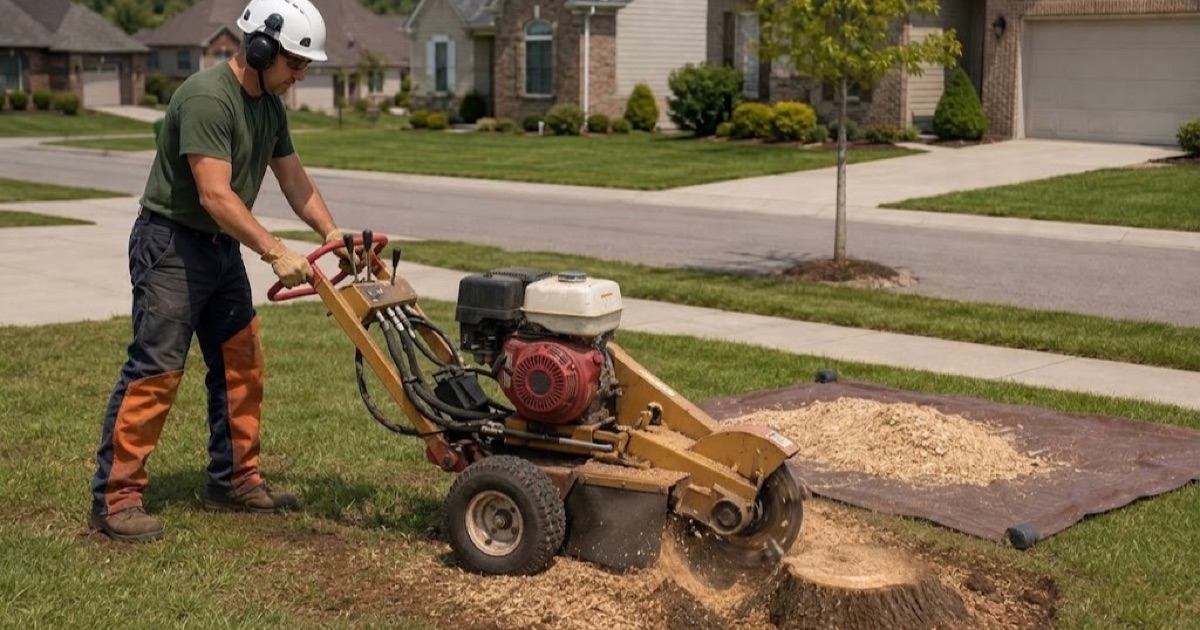
What a Tracked Stump Grinder Actually Does
A stump grinder is a carbide-toothed wheel that cuts the stump and the upper root plate into chips in place, working from the outside in. It does not dig, it does not pull, and it leaves the surrounding ground and the soil profile essentially intact, which is why it is the right tool in an established lawn or a planting bed. Tracked machines spread their weight and mark turf far less than a wheeled unit, which matters more here than it sounds — most of this city is irrigated subdivision lawn.
When Excavating the Stump Whole Is the Right Call
Grinding is the wrong answer where something is going through that ground. A footing, a driveway subgrade, a retaining wall, a utility trench or a pool excavation all need the root plate physically gone rather than chipped to a rated depth, and that is a machine-and-truck job with a hole left behind to fill. It costs more and it disturbs more. We tell you which of the two your project actually needs rather than selling the cheaper one and letting a builder discover the difference.
When the Right Answer Is to Leave It Alone
A stump at the back of an acre lot, inside a fence line or in an area being mulched out is often not worth touching. Left in place it decays slowly and harms nothing, and the money is better spent on the standing tree next to it. Species matters here: some stumps sprout persistently and are worth grinding for that reason alone, while others simply sit and rot. We will say which one you have.
Depth, Roots and the Limestone Underneath
How Deep the Wheel Reaches
A tracked grinder is rated to take roughly 12 to 16 inches below grade. That is comfortably enough to put turf, a bed or a fence post over the spot, and it is not enough to clear a footprint for construction. The number that matters is not the machine’s maximum but the depth your plan for that ground actually requires, which is why we ask what is going there before quoting rather than after.
Talbott, Mimosa and Where Rock Actually Starts
The two soil series that set the working depth around this hub are Mimosa, at 40 to 60 inches of solum over bedrock, and Talbott, at only 20 to 40 inches. On both of those a grinder rated to 12 to 16 inches stops on its own limit rather than on rock, so the popular story about grinders hitting limestone in the Basin is mostly wrong. Rock becomes a genuine factor in a different job: chasing a wide root plate, or excavating a stump whole on a Talbott profile. Where that risk exists, the bid names it up front.
Surface Roots and the Ground Around the Stump
A stump is the visible part of a structure that can run well past the drip line. Surface roots lifting a walkway or a driveway edge are ground separately and priced separately, because each one is its own pass and each one risks whatever is buried beside it. On the shallow residuum common here, trees compensate by spreading a wide flat root plate rather than rooting deep, so the roots you can see are often a fair guide to how far the rest of it goes.
The Grindings, the Crater and What Comes Next
How Much Material One Stump Produces
Grinding turns solid wood into chips, and chips take up several times the volume of what they came from, so even a modest stump leaves a surprising heap. Nobody expects that the first time. Deciding in advance whether the material stays or goes is what keeps a small job from ending in an argument, and it is the single most common omission we see on a competitor’s stump quote.
Backfill, Settling and Getting the Ground Level
The standard finish is to rake the grindings back into the crater and crown them above grade, because the ground under them keeps settling for a season as the remaining root mass decays. Where you want a flat lawn immediately, the grindings come out, topsoil goes in and the area is seeded, which is a different price. Seeding is quoted as its own line rather than folded in and assumed.
Replanting in the Same Footprint
A new tree cannot go straight into fresh grindings. Decomposing chips tie up nitrogen in the root zone and the ground is still moving, so a replant in the same spot means excavating the grindings and backfilling with soil first. In most yards, planting a few feet off the old footprint is both cheaper and better for the new tree, and we will say so instead of quoting the excavation.
Access, Utilities and Protecting the Rest of the Yard
Gate Widths on Post-1990 Subdivision Lots
Almost every lot in this city was platted after 1990, which usually means a fenced back yard reached through a single standard gate. Our compact tracked machines are sized for exactly that, so a back-yard stump does not turn into a fence panel coming out. We measure the access before quoting, because the honest alternative — taking a section of fence down and putting it back — is a real cost that belongs in the price rather than in a surprise.
Tennessee One Call Before the Wheel Turns
Anything cutting below grade near a service line gets a locate first. Tennessee One Call covers the public utilities, and the mark-up tells us where gas, water, electric and communications enter the property. What it does not cover are the owner’s own buried lines, so we ask about irrigation laterals, low-voltage lighting and pet containment wire and mark what you know about before we start.
Irrigation, Septic Fields and Shallow Systems
A septic field, a drain line or a sprinkler zone under a stump changes the method rather than the price alone, and sometimes it changes the answer to leave the stump alone. On properties with a field, the safest route is often to grind shallow and accept a stump that decays in place rather than to chase every root through the trenches. We would rather have that conversation at the estimate than write a repair invoice afterward.
- 20+ Years in Middle Tennessee
- Free Estimates
- Written Scope Before Work Starts