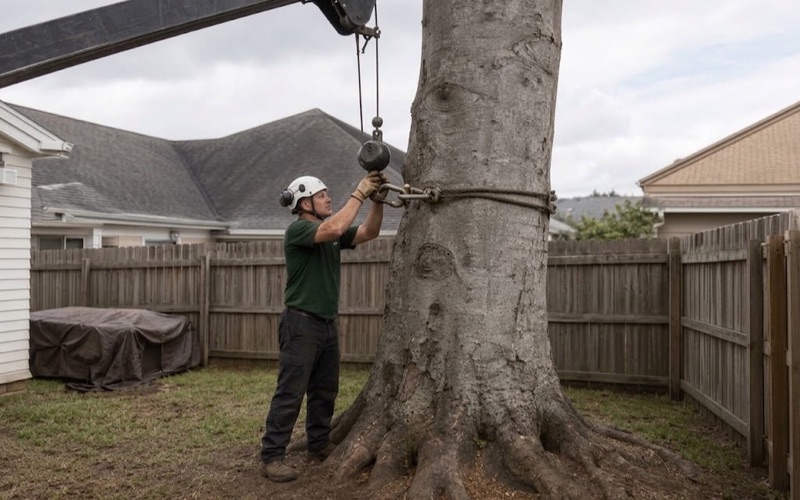
Spring Hill Tree Removal has handled tree removal in Smyrna for more than twenty years, and on this ground a job is settled below grade before it is settled in the canopy. Limestone sits close enough to the surface here to decide what a stump grinder can reach, how a root system is shaped, and what a mature tree does when the soil is saturated. A price built without looking at that is a price that gets revised in the driveway.
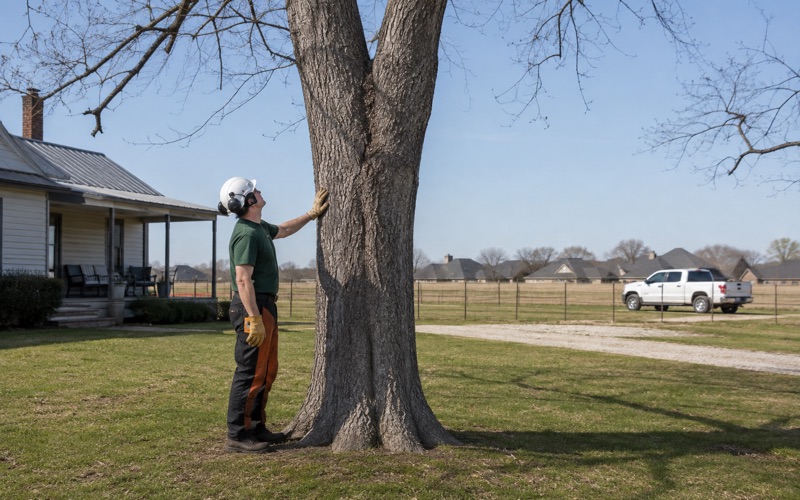
So we walk the site first. We read the root flare, the lean, the gate width a tracked machine has to fit through, and how much soil sits between the surface and the rock. Two trees of identical diameter at breast height, on two lots a mile apart, are routinely two different jobs in this town.
We also read the ordinance that governs the address rather than the one that governs somewhere else, and we put the scope in writing before a saw runs. Where a tree can be kept instead, cabled, braced, or pruned to the objectives and cut types the ANSI A300 pruning standard sets out, we would rather say so and hand you a written condition report you can give a neighbor, an insurer or an architectural review committee.
The stump is a soil question before it is a stump question
How deep the ground actually goes
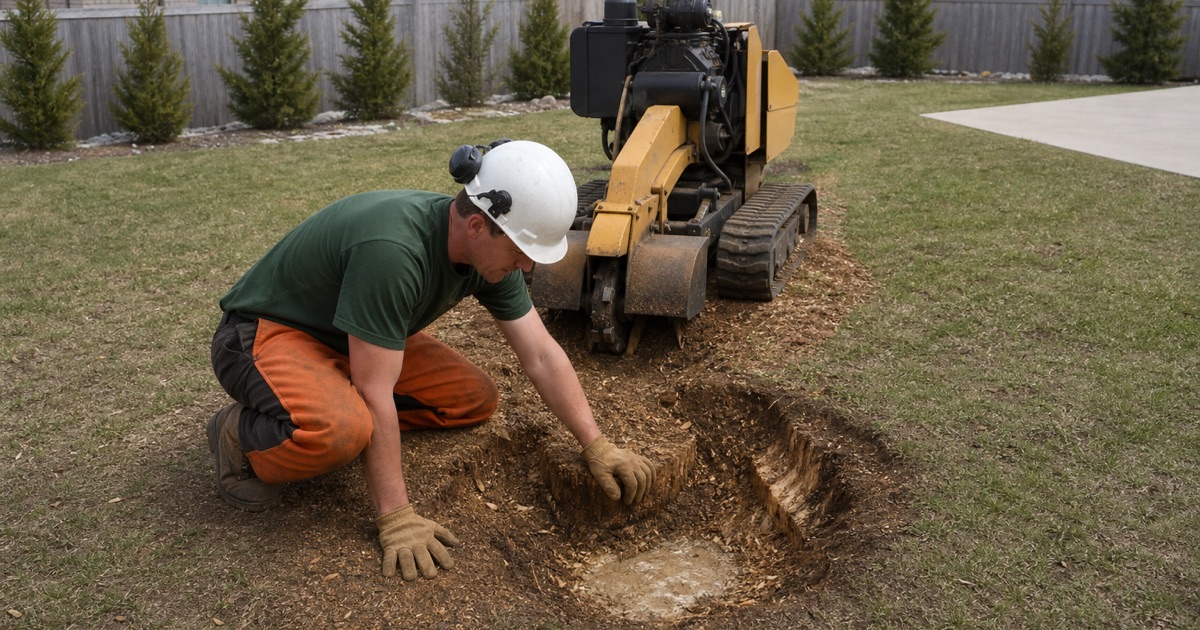
The soils under this town formed on clayey residuum weathered from limestone, and they are shallow by any measure. The Barfield series, whose type location is in Rutherford County, runs 8 to 20 inches to limestone bedrock. The Gladeville series is thinner again at roughly 3 to 12 inches, well drained and formed in weathered thin-bedded flaggy limestone, and the moderately deep Talbott series runs 20 to 40 inches.
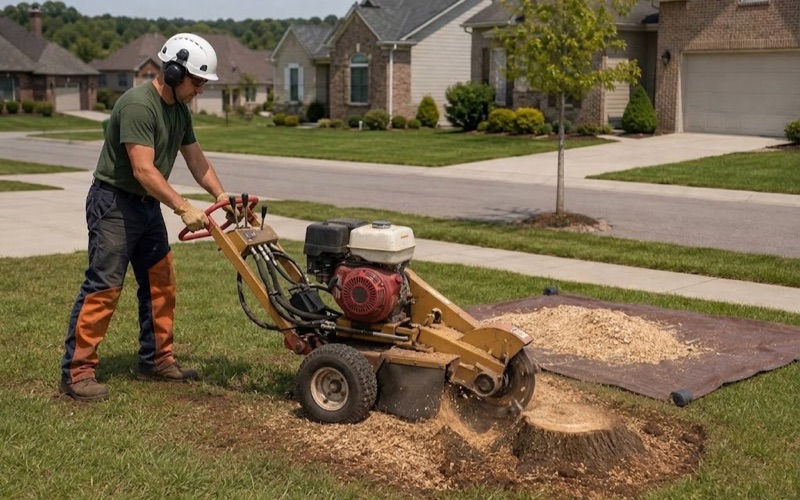
Those three numbers decide most of what a stump grind can achieve. A tracked stump grinder rated to cut 12 to 16 inches below grade will reach bedrock rather than the bottom of the root plate on a Barfield or Gladeville profile, so the depth is limited by rock and not by the machine. Where a deeper Talbott pocket sits under the stump, the same wheel finishes on its own rated limit instead.
Why we do not name a below-grade depth sight-unseen
A contractor who commits to a below-grade figure before seeing the stump is either guessing or is going to run out of soil. We will not do that here.
What we do instead is probe the ground at the stump, say what we expect the wheel to reach, and write that into the scope rather than leave it to the morning of the work. A shallow profile also produces a different volume of grindings and a different backfill than a deep one. We set out the trunk rounds, the stump, the grindings and the chips in writing, so the finished grade is a decision you made rather than a surprise you were handed.
Where a stump sits against a foundation, a drive or a service line, we file the Notice of Intent to Excavate with Tennessee One Call before anything turns, because grinding and root excavation are digging under that statute. Shallow soil tends to concentrate buried services in the same few inches a grinder wants.
Looking for tree-removal closer to La Vergne? See La Vergne Tree-Removal.
Roots against public works, and the barrier the town writes as a construction spec
Fifteen feet, or five feet of reinforced concrete
Smyrna’s landscape regulations take root conflict seriously enough to answer it as a construction detail. Trees of species whose roots are known to cause damage to public roadways or other public works may not be planted closer than 15 feet to such public works, unless the root system is completely contained within a barrier whose minimum interior dimensions are five feet deep and whose construction is four-inch-thick reinforced concrete, at Section 3.150(C).
Read that as a specification rather than a rule and it tells you what the town expects roots to do. Five feet of containment built of four inches of concrete is not the language of an ornamental concern. It is the language of a jurisdiction that has watched roots move pavement.
The provision governs planting on sites working from a landscape plan. It is not a retroactive obligation on the tree already standing in your front yard, and we say so plainly instead of using an ordinance as leverage toward a removal.
The tree already lifting a walk
When an existing tree is in conflict with a drive, a walk or a public roadway, the ordinance’s own two answers, separation or containment, are both unavailable after the fact. That narrows the honest options to managing the conflict, repairing the surface around the roots, or taking the tree out.
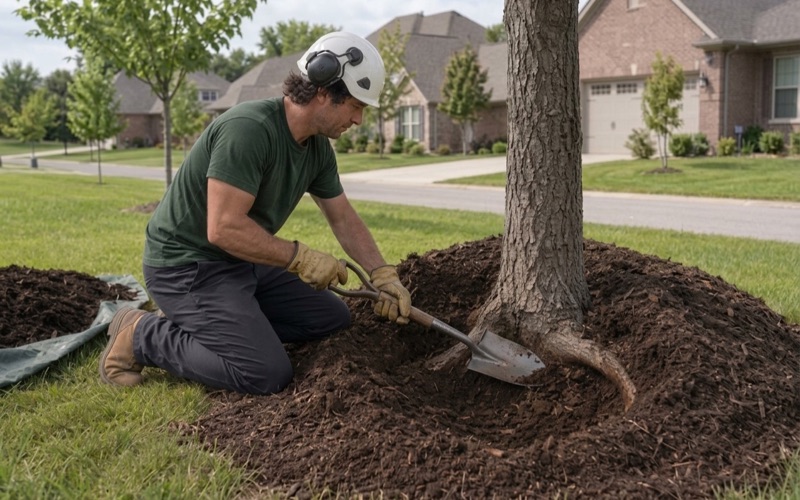
We start with a root collar excavation, with an air spade where the situation warrants it, to establish whether the roots doing the damage are structural or peripheral. On ground this shallow the distinction matters more than usual, because a tree here has very little root to spare and cutting the wrong one converts a pavement problem into a stability problem.
Utilities are the other half of the same question. Middle Tennessee Electric clears a right of way 40 feet wide, 20 feet on each side of the line, and its No Grow Zone for underground equipment allows no landscaping within 12 feet of the front of a transformer and 3 feet from all other sides, so we confirm which utility serves an address before quoting anything near a conductor.
What the ordinance requires, and what it does not
Does Smyrna require a tree removal permit?
No. Smyrna, Tennessee imposes no tree removal permit and no diameter threshold for taking down an existing tree on private property. The operative document is the Zoning Ordinance of Smyrna, Tennessee, dated October 14, 1986 and amended since, and Section 3.150(B) confines the whole landscape section to new site development and changes of use.
That is a negative worth supporting rather than simply asserting. The same ordinance carries six pages of detailed tree regulation at Section 3.150, specifying minimum crown spread, clear trunk height, caliper, root barriers, species exclusions and replacement periods. A document that particular about trees is demonstrably not silent about them, and it still asks nothing of a homeowner who wants one gone.
Smyrna is legally incorporated as a town, governed by a Town Council with a Town Planner, and it was the largest town in Tennessee by population at the 2020 census, with 53,070 residents. Landscape treatment plans go to the Planning Commission; a homeowner removing a back-yard tree is not in that process at all.
The 24-inch number people find online
Section 3.150(D) does contain a 24-inch figure, and it is a preservation credit rather than a threshold. An existing healthy tree of 6 to 12 inch caliper with at least 150 square feet of landscape area substitutes for two required trees, one of 12 to 24 inch caliper with at least 250 square feet counts as three, and one of 24 inch or greater caliper with at least 300 square feet counts as four.
Three things follow from how that is written. It is measured as caliper rather than as diameter at breast height, it rewards a developer for keeping a tree rather than granting anyone leave to remove one, and it applies only on a development site working from an approved landscape plan.
The version circulating online, in which a tree past 24 inches triggers a removal requirement with the charge dropped on a professional’s condition finding, describes Smyrna, Georgia. That is a different state’s ordinance and it carries no force at this address. Reading the rule for the town the tree actually stands in is why our answer to this question changes from one address to the next.
What Tennessee licenses, and what it does not
Tennessee issues no arborist or tree-care license of any kind. A state contractor license is required for work of $25,000 or more, and separately Rutherford County is one of nine counties that adopted the Home Improvement Contractor requirement covering residential work from $3,000 to $24,999, which carries $10,000 in financial responsibility and names landscaping in the statutory definition at T.C.A. 62-6-501(4)(A).
So a claim of state licensure in this trade describes something that does not exist in Tennessee. Judge a crew on the written scope, the insurance certificate and the condition report they leave behind, which are the things that actually tell you how the work will go.
How trees fail on shallow ground
A root plate that is wide instead of deep
Rooting depth here is capped by rock, and a mature tree answers that by spreading a wide but thin root plate rather than a deep one. That plate, not the taproot people picture, is the structure holding the whole tree up.
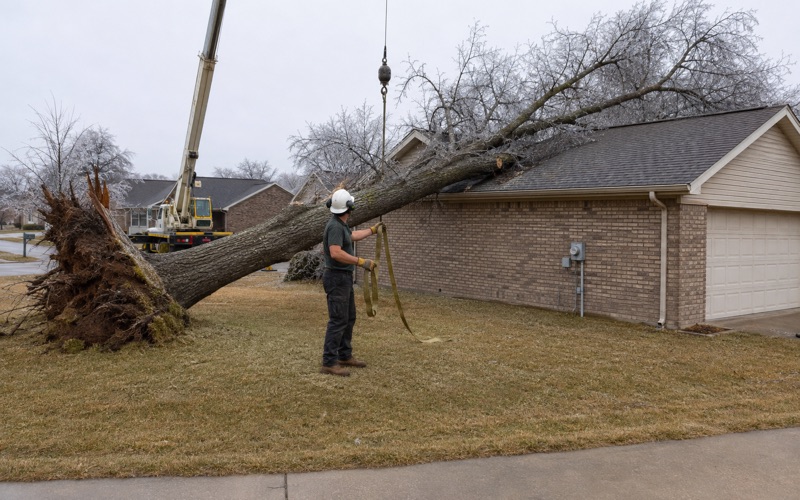
It is also why the characteristic failure on this ground is whole-tree windthrow rather than trunk breakage. When the soil goes saturated the plate loses its purchase on rock it was never anchored into, and the tree goes over intact, root mass and all, often taking a slab of turf with it.
Timing compounds the problem. The thin soils of this system dry out through summer and autumn and become saturated through winter and spring, which puts the wettest ground and the ice season in the same few months.
Ice is documented here, not a regional generality
The USDA Forest Service biophysical setting model for the Nashville Basin limestone glade and woodland system names periodic drought, fire, historic grazing and ice storms as the disturbances that restrict woody growth and hold the glades open. Ice is part of how this landscape came to look the way it does.
The recent local record is specific. At the Smyrna-Rutherford County Airport the National Weather Service Nashville office recorded 2.1 inches of snow, 0.3 inches of freezing rain and temperatures as low as minus 4 degrees for the January 24-28, 2026 storm, which are event observations rather than climatological normals. Middle Tennessee Electric’s president and CEO Chris Jones described the restoration as one of the most significant challenges in the cooperative’s 90-year history, with crews completing a repair and then watching further trees fall onto the same lines as they drove away.
We plan storm response around the loading this area actually records rather than a generic script. A tree that reads as sound in August is a different proposition in January on ground like this.
The trees this ground actually grows
Smyrna sits in the Inner Nashville Basin, EPA Level IV ecoregion 71i, on flat-lying Ordovician limestone, and the woody vocabulary follows the rock: post oak, chinkapin oak and eastern redcedar dominate, with winged elm, blue ash, redbud and hackberry alongside them. Cedar glade species rig and fall differently from the deeper-soil canopy elsewhere in Middle Tennessee, and twenty years across the Outer Nashville Basin, the Inner Basin glades and the Western Highland Rim is largely twenty years of learning which one is in front of us.
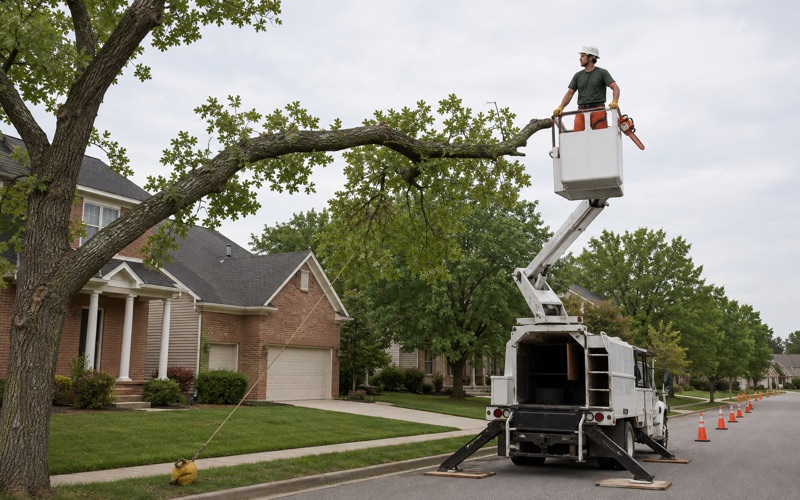
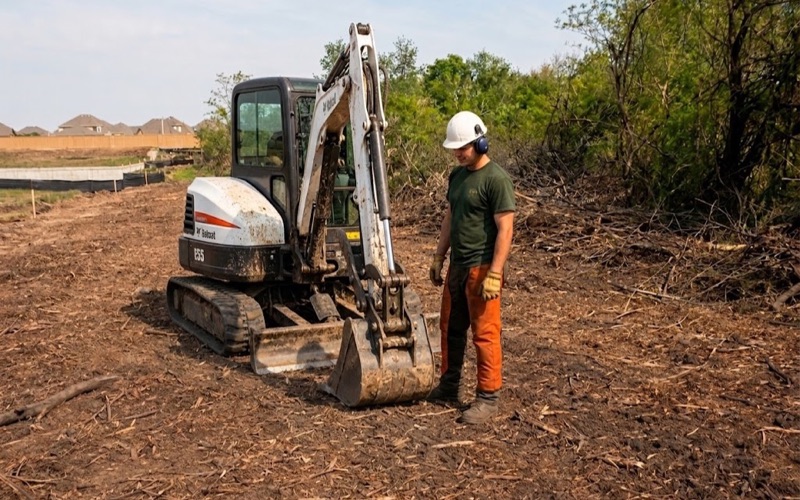
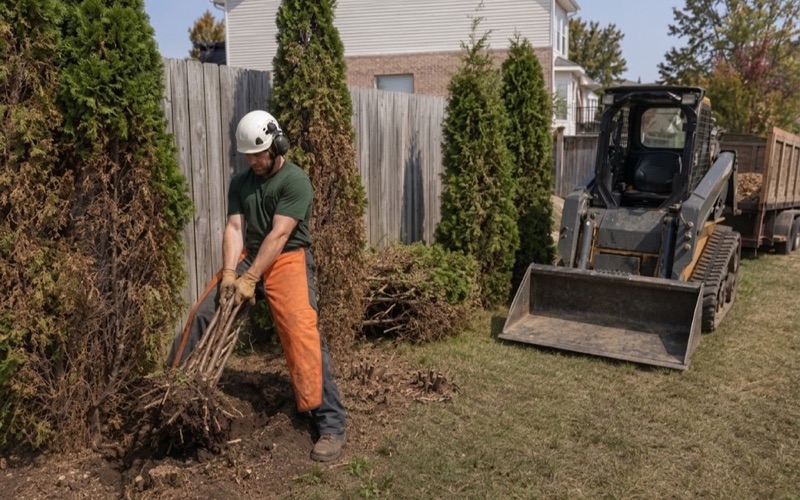
Most of the removals we do here are on newer subdivision lots. The median Smyrna housing unit was built in the 2000-2009 band, and the town holds 10,272 owner-occupied one-unit detached homes, which in practice means back-yard trees behind a gate. That is why we run compact tracked equipment that fits through one, so a subdivision removal does not have to become a crane job, and why we keep crane and rigging capacity for the jobs that genuinely need it.
The right answer on shallow ground is often less than a removal, and we will tell you when it is. Where a tree carries co-dominant stems with included bark, or a conk at the base, the choice between cabling and bracing, a crown reduction and taking it down is a judgment we will put in writing before you have to make it.
- 20+ Years in Middle Tennessee
- Free Estimates
- Written Scope Before Work Starts