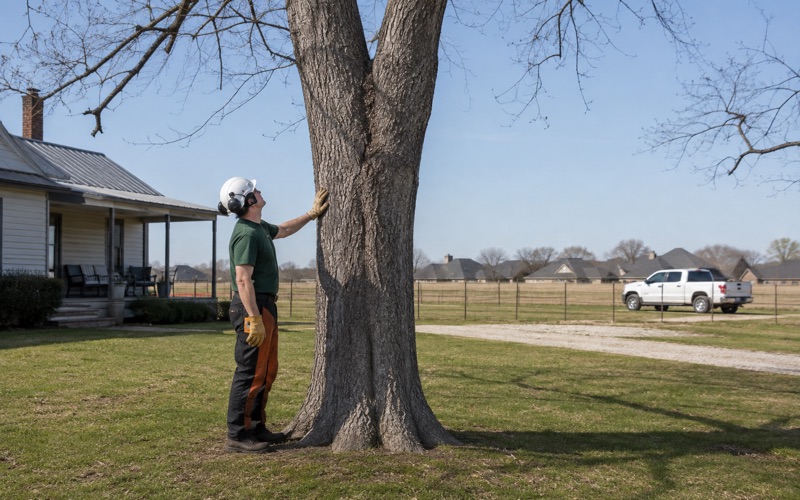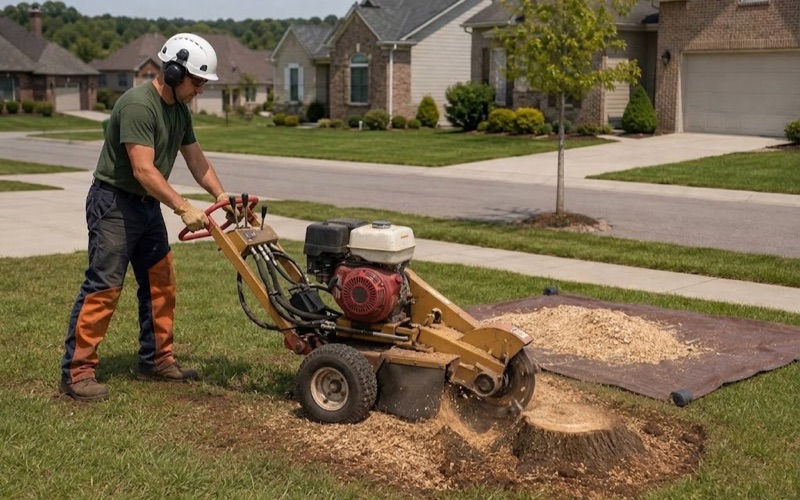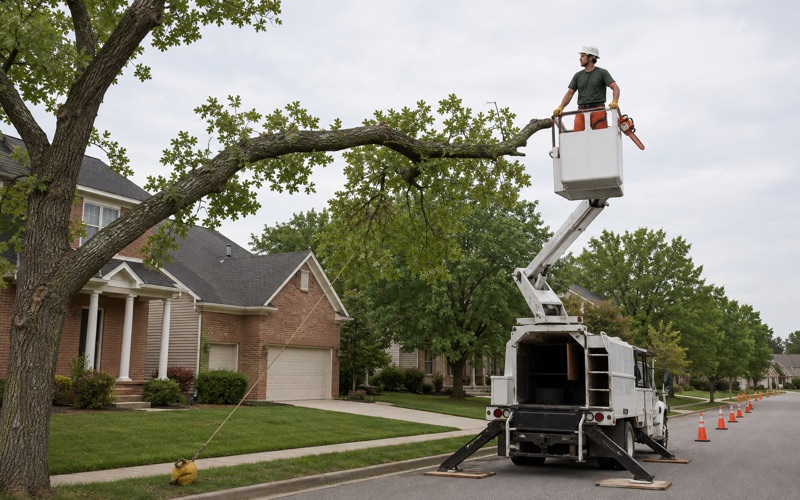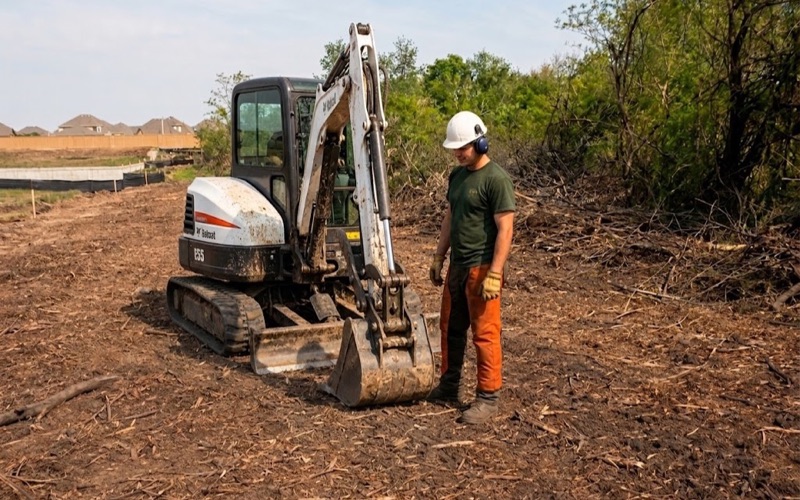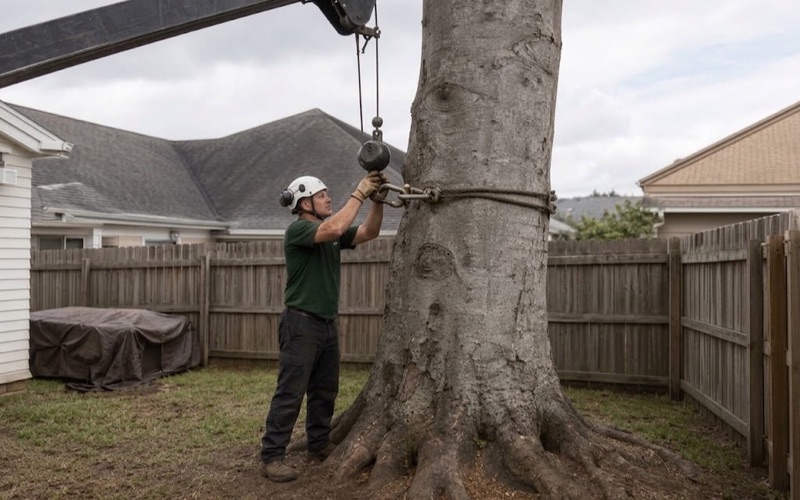
Spring Hill Tree Removal handles tree removal in Nolensville with more than twenty years of Middle Tennessee tree work behind the crew, and the first thing we establish at a new address here is not the species or the lean but the status of the lot itself. In this town a tree’s legal standing is decided by whether a grading permit is open on the ground it stands in, not by whose name is on the deed. That one question changes who has to approve the cut, what paperwork the job runs on, and what it costs to get it wrong.
On ground still under construction, every existing tree of five inches in diameter and up has already been plotted, measured and graded for health on a stamped plan, with money attached to each one. On a finished yard a few hundred feet away, the Town asks for no permit at all. We read the ordinance for the address the tree actually stands in rather than assuming the answer carries across a property line, and we tell you which side of that line your job falls on before we quote it.
A grading permit, not a deed, decides who signs off
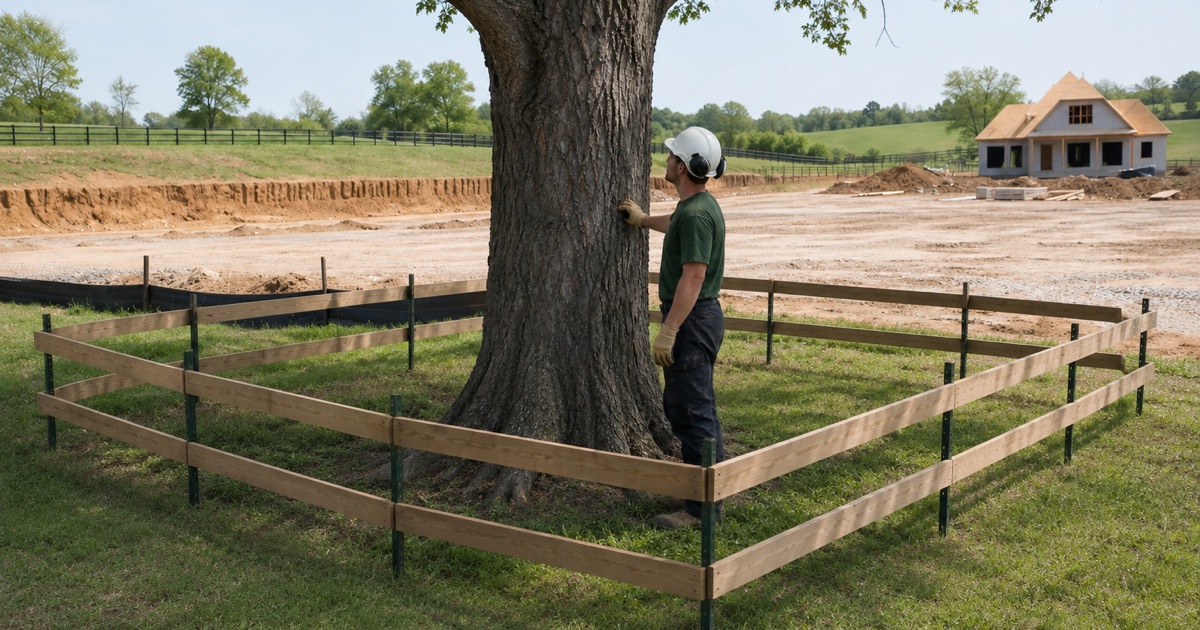
Nolensville’s tree provisions sit in the zoning code, and they are triggered by development rather than by ownership. Subsection 6.1.4(D) of Title 6, as amended by Ordinance 22-10, attaches to construction, site plans, subdivisions and grading permits, and we have found nothing in the Town’s code requiring a homeowner on a finished lot to obtain a Town permit before taking down a yard tree. A crew working ahead of a builder is inside the ordinance; the same crew clearing a dead maple out of a settled back yard generally is not.
That distinction carries more weight here than it would in a town that finished growing decades ago. Nolensville went from 5,861 residents in 2010 to 13,829 in 2020, and a great deal of its ground has been through a grading permit recently enough that the approved plan is still the governing document. Before we quote, we ask whether the lot is still inside an open permit and, on new construction, who is holding the plan set.
Who administers this
The Board of Commissioners at 7218 Nolensville Road adopts and administers the zoning code that governs tree retention, inventory and replacement, and issues the grading permits those standards hang on. The Town moved to a manager-commissioner form of government in 2020. The Planning Commission reviews and approves site plans and subdivisions, and it holds the discretion to vary the replacement ratios or to accept a payment in place of replanting.
When two provisions disagree
The ordinance settles its own conflicts in a single direction. Where the tree provisions collide with anything else in the Zoning Code or the Subdivision Regulations, the provision requiring greater retention of mature trees applies. That is worth knowing before anyone starts a saw on a development lot, because the looser of two readings is not the one the Town will stand behind.
Looking for tree-removal closer to Fairview? See Fairview Tree-Removal.
What the inventory on a construction lot requires
Ordinance 22-10 lowered the threshold that decides which trees have to be surveyed at all. Landscaping plans for single-family residential development must give the species, the size at diameter at breast height, and the location of every existing tree of five inches DBH or greater inside an area to be disturbed by construction, measured four and one-half feet above natural grade. The previous threshold was eight inches, so a plan drawn under the older rule inventories a materially smaller set of trees than the current one does.
The inventory is more than a map. Each tree’s health condition has to be recorded as poor, fair or good, together with contact information for the professional who made that determination, and the landscape plan itself must be prepared by a licensed landscape architect. On a development job the tree survey we work from is somebody else’s stamped drawing, and our part is to execute against it rather than to redraw it.
Preservation is the default on the big stems
All trees of twenty-four inches or greater must be preserved, if possible, on single-family and non-single-family development alike. Existing tree coverage on a lot that serves as a buffer may not be disturbed at all. Those two rules decide more on a typical site than the removal rules do, and we would rather learn at the walkthrough that a stem is designated for preservation than learn it at the inspection afterward.
Replacement runs two inches for every one
Absent Planning Commission approval, a removed tree of five to ten inches caliper must be replaced with a tree of at least two inches caliper, and a removed tree greater than ten inches caliper with a tree of at least five inches caliper. Both cases work out to two inches of caliper planted for every inch removed. A developer may instead pay the estimated cost of those trees into a Tree Save account the Town holds and spends on buffering and screening plantings elsewhere.
The penalty and the inspection standing behind it
Removing a tree in violation of the terms of a grading permit carries a $500 fee for each tree, paid into that same account. Before a grading permit issues, the applicant pays for a third party the Town hires to inspect the site after grading and confirm that nothing designated as preserved came down. That inspection is why we ask for the marked plan up front, and why we photograph protected stems before equipment moves onto the ground.
Taking a tree out of a settled Nolensville yard
Once the grading permit on a lot has closed, the calculus changes completely. There is no Town application to file and no inventory to update, so the decision is yours and the constraints are the practical ones: what stands over the roof, what the neighbor’s side of the fence looks like, and how the wood comes out. We still put the scope in writing before we start, naming what happens to the trunk rounds, the stump, the grindings and the chips, because that is where most tree-work disputes actually begin.
What a written condition report is for
Plenty of calls here are not really removal questions. When a homeowner wants to know whether a leaning tulip poplar is a hazard, or whether co-dominant stems with included bark can be held together with a cable, we will say so, and we will tell you when cabling, bracing or crown cleaning is the better answer than the saw. When the question is going to be argued with somebody else, we put a written tree condition report in your hands that you can hand to a neighbor, an insurer or an HOA architectural review committee.
Licensing, stated accurately
Tennessee issues no trade-specific tree-care or arborist license, so there is no such credential for anyone in this state to hold. A state contractor license is required at $25,000 and above in materials and labor. The Home Improvement license, which covers residential work in the $3,000 to $24,999 band, applies only in the counties that adopted it, and Williamson County is not one of them. Below the state contractor threshold there is genuinely no license for a homeowner here to ask for, and anyone implying otherwise is misstating the law in this county.
Trees standing in the utility right of way
Middle Tennessee Electric serves the town, and the Town of Nolensville directs residents to MTE for electric service. The cooperative clears a forty-foot right of way, twenty feet on each side of the line, and its crews cut back or eventually remove trees standing inside it, using herbicide selectively on woody-stemmed regrowth in that corridor. It also runs a network of right-of-way contractors reachable at (877) 414-7685. We check which utility serves an address before quoting any work near a conductor rather than assuming.
Soil, stumps and getting the wood off the lot
The ground under this town is not uniform, and a stump grind is where that shows up first. On the flat valley and terrace ground along Mill Creek the working soil is Armour silt loam, a well drained series formed in old alluvium, valley fill, or alluvium over limestone residuum, with bedrock more than five feet down and slopes of zero to twenty percent. A grinder set to work twelve to sixteen inches below grade is in soil the whole way there, which is the straightforward case.
The harder case is abrasion rather than depth. Bodine gravelly silt loam, the most extensive series mapped in Williamson County by acreage, carries thirty-five to eighty percent chert rock fragments through the particle-size control section. Chert in that volume is what dulls a grinder wheel and turns a routine stump into a teeth-replacement job, so we price grinding on what is in the soil and not on stump diameter alone.
What grows here, and how it comes down
Nolensville sits in the Outer Nashville Basin, EPA Level IV ecoregion 71h, and the species that assignment predicts are the ones we take down here: white oak, northern red oak, tuliptree, sugar maple, hickory, eastern redcedar, black locust and honeylocust over limestone residuum. The mixed stand on these terrace soils runs to the same list, adding elm, hackberry, beech, black walnut and ash. Knowing which of them stands over the driveway is most of what makes a removal quiet instead of eventful.
They do not all come down the same way. A tuliptree with long, straight, brittle wood asks for different rigging than a hackberry full of tight unions. An eastern redcedar leaning hard over a fence line is a third problem again, and we plan the rigging around the species and the target rather than the diameter alone.
Where the brush and the wood go
Brush and clean wood from a Nolensville job go to the Williamson County Landfill, operated by WM, or to the county convenience centers; the Town runs no landfill of its own. Brush delivered to a convenience center has to be three feet in length or less, which makes it a cutting and chipping decision on your driveway rather than a problem discovered at the gate. From May 4, 2026 until January 2, 2027, every incoming load at the landfill is charged regular tonnage fees, and the waiver residents may remember is suspended for that entire window.
That suspension is a real line item rather than a footnote. An estimate written against the older waived-fee arrangement is describing a window that is currently closed, and we would rather show you the haul-off cost in the quote than discover it together at the end of the job. Estimates are free, and the disposal figure is in ours from the start.
- 20+ Years in Middle Tennessee
- Free Estimates
- Written Scope Before Work Starts