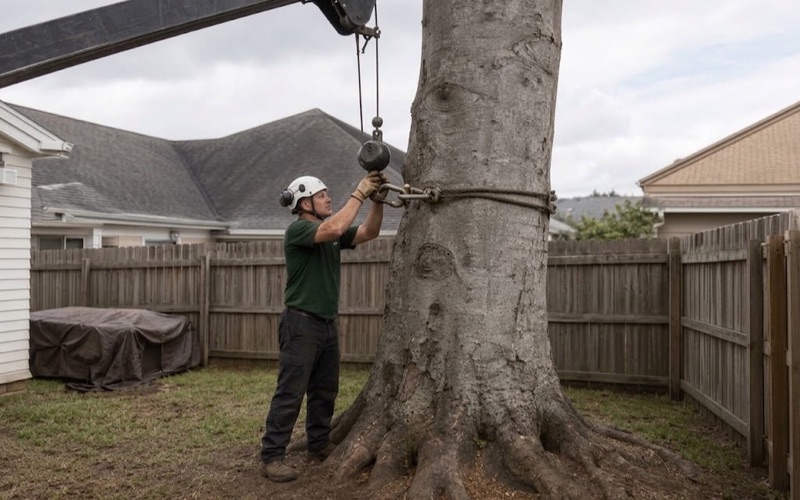
Spring Hill Tree Removal has spent more than twenty years on tree removal in Mount Pleasant and across Middle Tennessee, and the quote we hand you starts underneath the tree rather than at the top of it. A takedown is planned from the crown down. A stump is planned from the dirt up, and on this ground the second half of that sentence is where the surprises live.
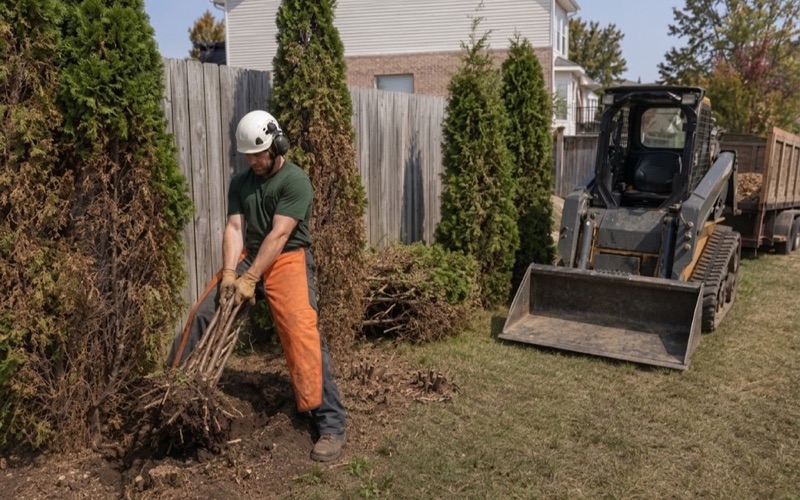
We put the inclusions in writing before a saw runs: the trunk rounds, the stump, the grindings and the chips. We check which utility owns the wire over the address before quoting any work near a line rather than assuming, and we bring compact tracked equipment through a back-yard gate when the alternative would be turning a subdivision tree into a crane job.
Estimates are free, and the tree condition report comes in writing so you can hand it to an insurer, a neighbor or an HOA committee. If a tree can be cabled, braced or pruned instead of removed, we will say so before we quote a removal.
This Is a Phosphate Town, and the Ground Records It
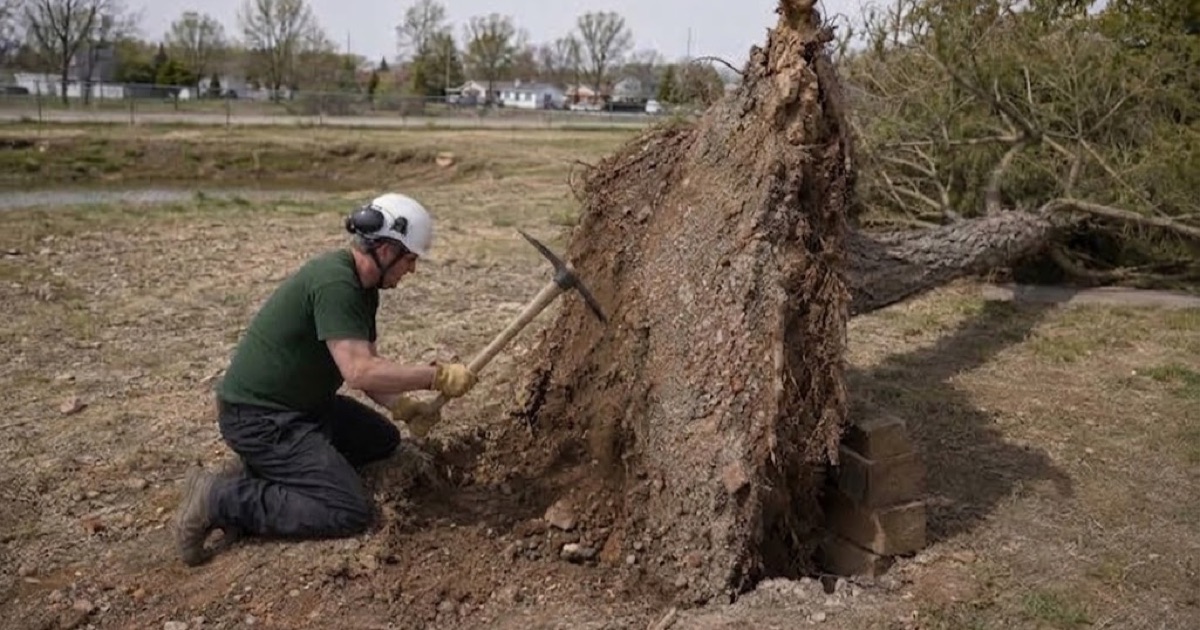
Brown phosphate rock made this city, and mining it went on in and around Mount Pleasant for roughly a century. It ended in 1991, when Rhone-Poulenc, owner of the former Stauffer operation, and Occidental Chemical both ceased operations here. What the industry left behind is not only a nickname and an eight-block downtown of 1870s-to-1950s buildings. It left ground that was opened and closed again.
That matters to a tree crew for one reason. Where a pit was dug and backfilled, or where a spoil bank was piled, there is no undisturbed soil profile left at all. The layers a soil scientist reads are gone, mixed or turned over, and the parcel no longer behaves like the ground next to it.
Why a Published Soil Figure Stops Answering
Soil series descriptions publish a depth to bedrock, and on undug ground that figure genuinely helps plan a grind. On mined-over ground it does not, because it describes a profile that was never disturbed. A former pit or a spoil bank is not the series a map names over it, and no one can predict from the series alone how deep a wheel will run or what a machine meets at eighteen inches.
The same limit applies to the tree standing on it. A root plate spreads through whatever the tree could actually root into, and reworked fill is not the volume, shape or grip that native ground would have given it. Windthrow risk on a lot like that gets read off the tree and the site in front of us, not off a map sheet.
What That Changes About Stump Grinding
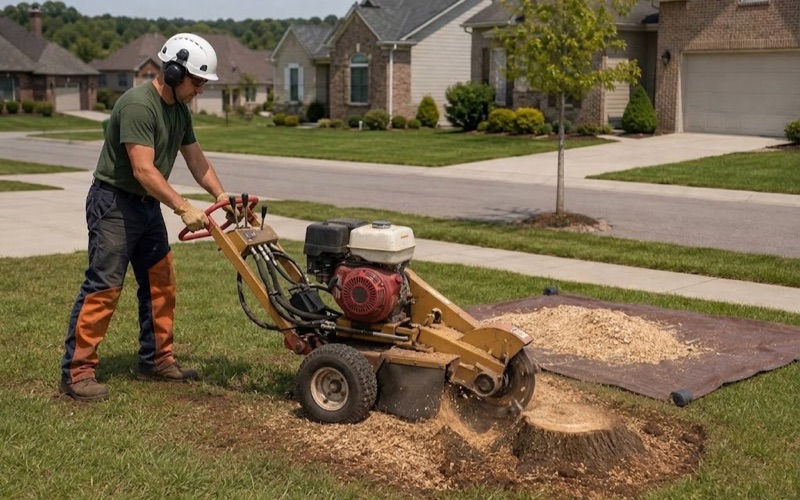
We price stump grinding here with the disturbance in mind and we say so on the estimate, rather than discovering it with the wheel and coming back with a number. Where a parcel’s history points to mined or reworked ground, we plan for a grind depth that varies across the stump and for backfill that does not settle the way native soil settles.
It changes what we agree to leave behind, too. Grindings from a mixed backfill are not a clean planting medium, and a homeowner who intends to put a replacement tree in the same hole needs to hear that before the machine is loaded out. The disposition of the grindings goes in writing with everything else.
Looking for tree-removal closer to Lewisburg? See Tree-Removal Services in Lewisburg.
The City Owns the Gas Under the Yard and the Line Over the Tree
Mount Pleasant supplies its own water, sewer and natural gas along with sanitation, through the city Utilities Department. An underground gas main in the street right of way is a city asset here, and gas is precisely the utility that turns stump grinding and root excavation into a locate question rather than a formality.
The March 2025 tornado made that point in the worst way available: it severed gas lines as well as power lines in this city. A grinder wheel and an air spade both work in the first two feet of soil, which is the same ground a service line runs through.
The Locate Comes Before the Grinder
We put in a Tennessee One Call locate before grinding a stump or opening a root collar anywhere near a structure, a meter or a street frontage, and then we wait it out. On a lot where the ground has already been reworked once, the cover depth over a buried line is one more thing that cannot be assumed from a standard.
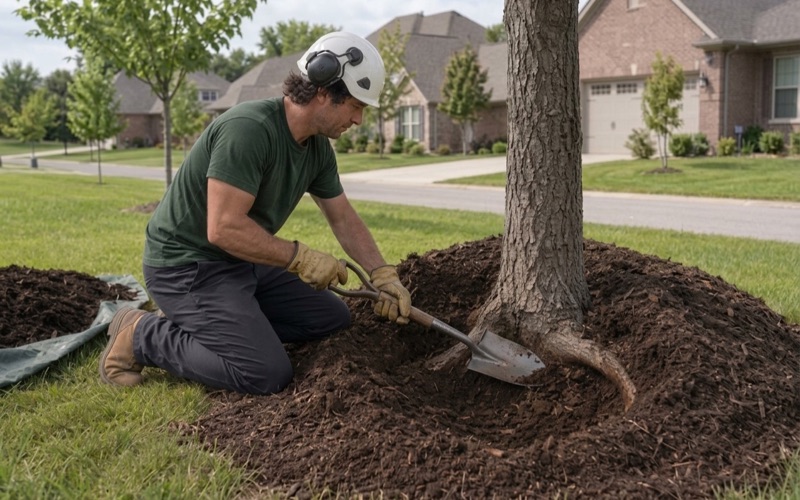
Root collar excavation and radial trenching are useful work, and done with an air spade instead of a blade they expose a root flare or decompact soil without cutting what they find. They are still excavation. They still wait for the marks.
Two Utilities, One Address at a Time
Electric distribution inside the city is municipally owned. Mount Pleasant Power System, at 123 North Main Street, is a TVA local power company incorporated in 1939, serving more than 3,900 residential and business customers over more than 360 miles of line, and it is a city department rather than a cooperative or an investor-owned utility.
Duck River Electric Membership Corporation serves parts of the surrounding county, and its outage reporting names substations in this area. Which utility holds the right of way over a given tree is therefore an address-level question, answered off the customer’s bill instead of guessed from the city name. We settle it before quoting anything near a conductor, because right-of-way clearance on an energized line is line-clearance work and is nobody’s afternoon project.
Topping Is Prohibited Here, and the Ordinance Names Its One Exception
The Zoning Ordinance of the City of Mount Pleasant, Section 11.4 and Appendix E, adopted as Ordinance No. 2018-1028 and effective November 20, 2018, states that topping of trees is strictly prohibited, except that Pyrus calleryana species may be pruned to prevent wind damage. That is the entire exception, and it is the only one the ordinance grants.
That carve-out is worth reading precisely, because it is easy to garble. The ordinance carries no prohibited species list at all, so Callery pear is not banned and not marked for removal. It is simply the one species the topping prohibition steps around, on the narrow ground of preventing wind damage, and it does not appear on the ordinance’s recommended plant list either.
We do not top trees, in this city or any other. Crown reduction, crown cleaning, crown thinning, crown raising and deadwooding are defined objectives with defined cut types under the ANSI A300 pruning standard, and a pair of co-dominant stems with included bark is a cabling and bracing conversation rather than an excuse for heading cuts.
Replacement Ratios and Credit for a Tree You Keep
Where the landscape standards apply, a tree removed at 10 inches diameter at breast height or greater has to be replaced at a 1:2 ratio in caliper inches. A 20-inch tree is replaced by new trees totaling 10 caliper inches, which is neither a like-for-like replacement nor a single sapling.
A tree you keep works in your favor. A retained tree of 20 inches DBH or greater may earn 50 percent credit toward that replacement requirement if it is left undisturbed, which is a concrete reason to ask whether a marginal tree can be protected and pruned instead of taken out. Replacement stock is specified as well: a shade tree goes in at 2.5 inches caliper minimum, an evergreen at 6 feet in height.
The Land Disturbance Permit Reaches Clearing Work
When earth-moving is involved, the city’s Land Disturbance Permit comes with the job. It is issued by the Department of Planning and Zoning at 100 Public Square, it requires a preconstruction meeting with the Planning and Zoning Director before construction begins, and the form asks for the contractor’s Tennessee license number and expiration date.
Its checklist also requires designated areas such as a non-disturbance forested buffer to be marked off and protected, with no heavy equipment operated or stored inside them and no materials handled there. That is a tree protection zone under another name, and putting the fencing up before the machines arrive costs far less than a stop work order does.
After the March 2025 Tornado: Debris, and Where It Legally Goes
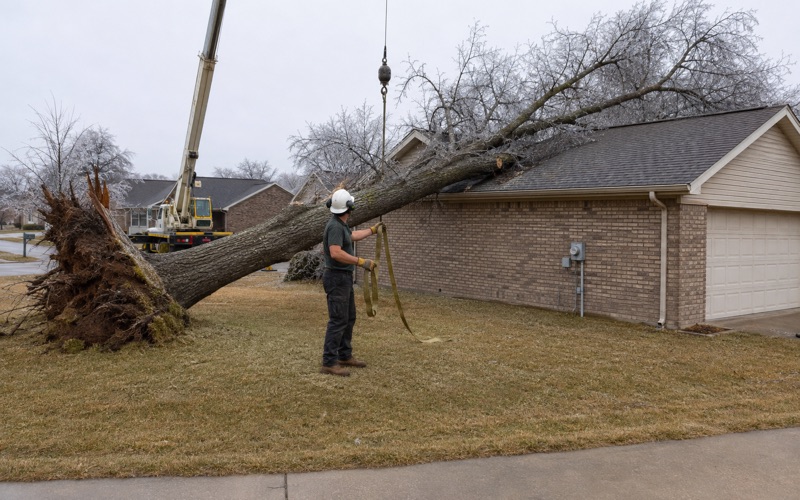
Around 12:14 a.m. on March 31, 2025, an EF-1 tornado with estimated peak winds of 100 mph tracked roughly 4.1 miles through the city on a path about 300 yards wide, with damage concentrated just off Old Sunnyside Lane. Dozens of trees were knocked down or onto houses, one came down on a residence in the Hunters Glen subdivision without injuries, fences were destroyed, roofs needed repair, and power and gas lines were severed.
That was not a one-off to be filed away. An EF-0 with 75 mph peak winds touched down just west of the city on August 31, 2017, snapping large limbs and uprooting trees along a 1.5-mile path. Ice is the other load case rather than a substitute for wind, and the January 2026 storm left half an inch or more of it across Middle Tennessee.
We plan storm response around those two loads, straight-line wind and ice, because that is what the record here actually holds rather than what a generic script assumes. It also sets the order of the work afterward: what is hung, what is leaning and what is merely broken get sorted out before anything gets cut.
The Disposal Gate Is Real, and It Is Not Free
Debris from a removal has one lawful county route for a contractor, and that route is gated. The Maury County transfer station at 1233 Lawson White Drive in Columbia charges $78.00 per ton with a $25.00 minimum, and a business cannot simply drive onto the scale: the Solid Waste Department requires a W-9, a certificate of insurance and a Maury County business license, approved on a commercial account, before that business may dispose of waste there.
The county’s convenience centers are not an alternative for us. They take residential waste only, with proof of residency, and do not accept commercial or business waste at all. A bid that treats disposal as a rounding error is quietly assuming access to a gate it has not been approved for.
What the City Will Collect From a Resident
City brush collection exists and it runs by appointment rather than on a route day. A resident calls the Sanitation Department to schedule, gives a name, an address and a description of the items, and sets neatly piled brush at the curb once the pickup is booked.
Yard waste caused by natural growth or by storm damage is accepted, but leaves and lawn clippings have to be bagged in approved biodegradable bags first, and the department states plainly that it is not responsible for shoveling, raking or picking up an accumulation of yard waste that was not pre-bagged. Bulky item collection is by appointment too, with three pickups allotted per resident per year.
We price disposal into the job instead of leaving a pile at your curb and calling it finished. When hauling is part of the work, the tonnage goes through the county gate on our account, and the estimate says so before we start.
- 20+ Years in Middle Tennessee
- Free Estimates
- Written Scope Before Work Starts