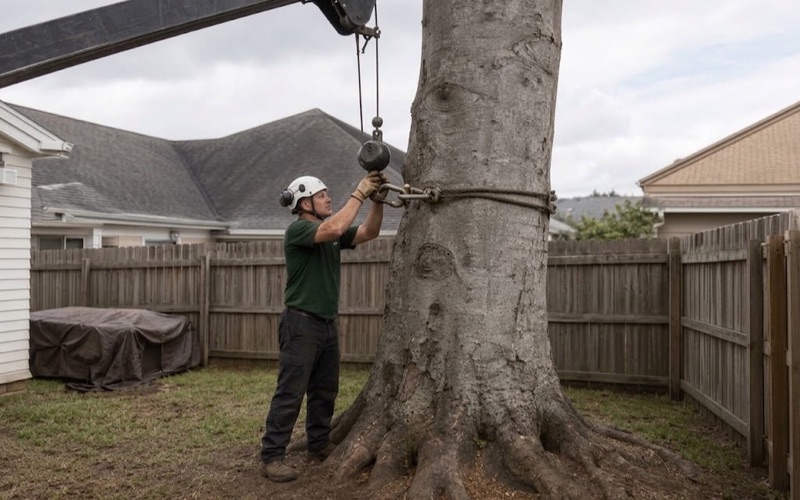
Spring Hill Tree Removal has handled tree removal in Lewisburg and across Middle Tennessee for more than twenty years, and the first thing we do with a Lewisburg address is read the code that governs it. Cities in this region answer the same questions in different ways, so we do not carry an assumption from one municipality to the next.
On most jobs inside this city the counterparty is the municipality itself. The power line above the tree and the gas main under the stump both belong to city boards rather than to an investor-owned utility, a limb reaching out over a street stays unlawful until the city manager authorizes it in writing, and the refuse ordinance says in terms that the city will not collect a contractor’s wood.
That changes the quote and the calendar, not only the paperwork. So we put the mechanics down in writing before a saw comes off the truck: who locates the utilities, who signs what, where the wood ends up, and what is included in the price, meaning the trunk rounds, the stump, the grindings and the chips. Estimates are free, and when a tree can be pruned, cabled or braced instead of removed, we say so.
Whose lines and mains a Lewisburg crew is working around
Before we quote anything within reach of a conductor, we settle which utility owns it. That is a real question in this part of the state, and the answer at a city address is not the answer a mile outside it.
The electric system over the tree is city-owned
The distribution system inside the city limits is municipal. The municipal code creates a three-member Lewisburg Electric Power Board, appointed and organized under Tennessee Code Annotated title 7, chapter 52, and the system trading as Lewisburg Electric System is a TVA local power company. Clearance over a city address is a conversation with that system, and we open it before the climb rather than after.
Duck River Electric Membership Corporation keeps a district office at 991 South Ellington Parkway, which is inside the city, and that address misleads people regularly. The cooperative serves the surrounding county rather than the city system’s territory, so an office in town does not make it the utility at a given city property. We confirm the serving utility from the address itself rather than from what is nearby.
The gas main under the stump is municipal too
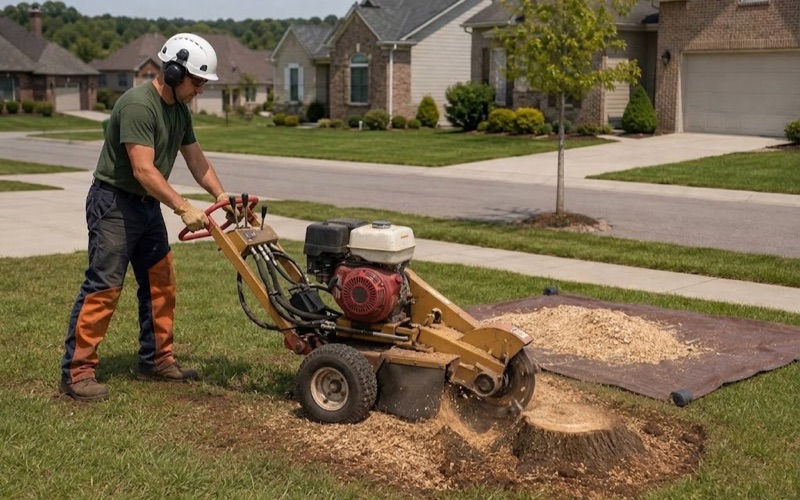
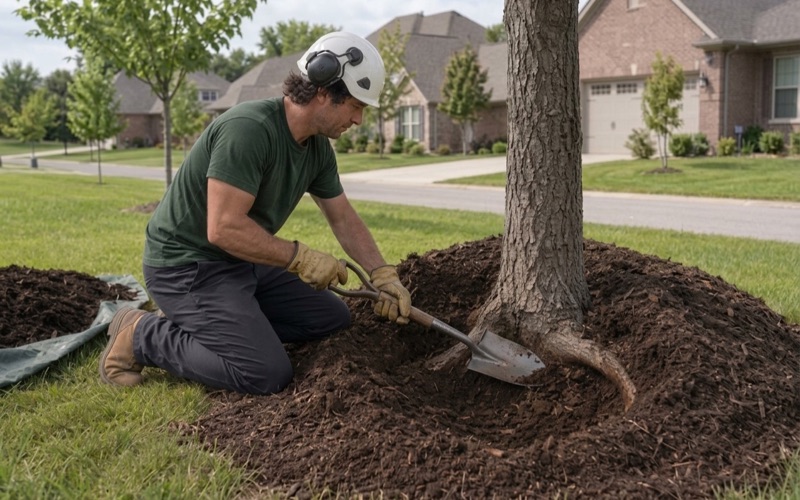
The city also runs its own natural gas distribution system, under a gas board created in the same title of the municipal code as the electric board. On a stump grind, a root collar excavation or any trenching near a service line, the buried main being located is a city asset. We call the locate in through Tennessee One Call and wait for it, and nothing turns below grade until the marks are down.
That municipal footprint is easy to see in person. The Planning and Codes Department, which administers the municipal code and the stormwater program, works out of 505 N. Ellington Parkway with its entrance in the Lewisburg Gas Department building, so two of the offices that bear on a tree job share one door.
Looking for tree-removal closer to Forest Hills? See Forest Hills Tree-Removal.
Limbs over the street and the permits that attach to the ground
What the city manager has to sign
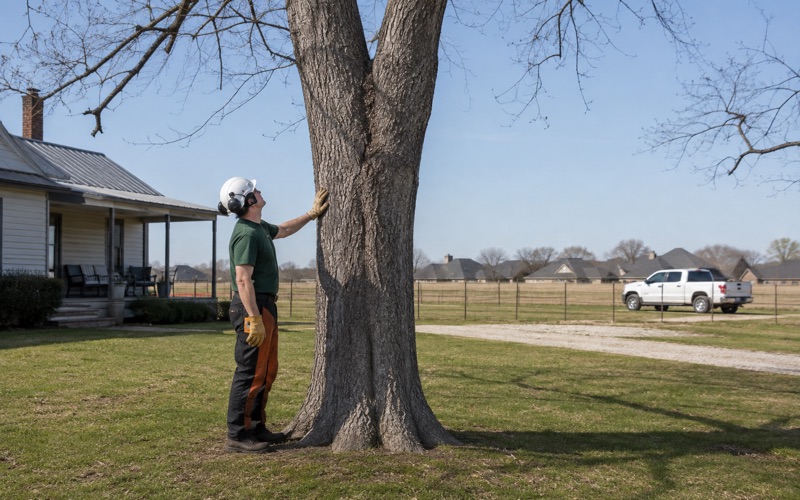
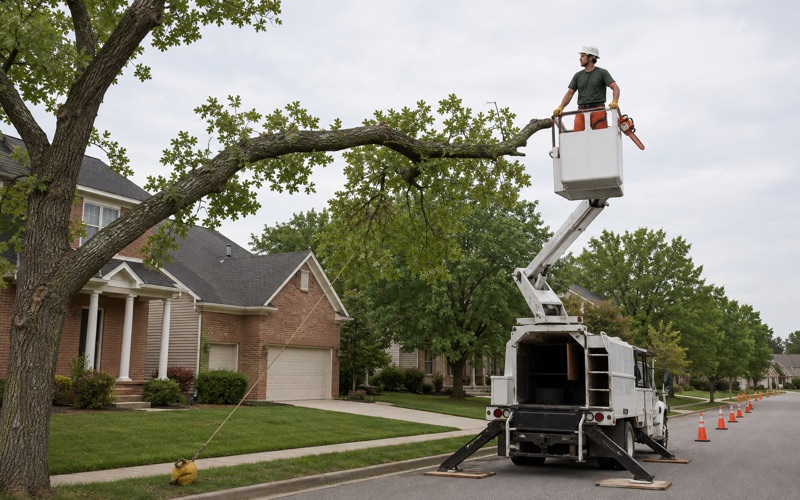
Section 16-302 makes it unlawful for a property owner or occupant to allow any limbs of trees on his property to project out over any street or alley, except when expressly authorized in writing by the city manager after a finding that no hazard will be created. That is written as a condition of the tree rather than of the work, so it reaches a limb that simply grew there. It is one of the more common reasons a homeowner here calls us about a tree that is otherwise healthy.
Section 16-303 works the same way at corners, making it unlawful to maintain a tree, shrub, sign or other obstruction on private property that keeps drivers on public streets or alleys from getting a clear view of traffic when approaching an intersection. Crown raising over the pavement and a clean sight line at the corner are ordinary pruning objectives, and we work them to the cut types the ANSI A300 pruning standard defines. We do not top trees to get there.
Cutting into the pavement
Chasing a root or grinding a stump inside the street right-of-way is a permitted act in its own right. Section 16-101 makes it unlawful to make any excavation in a street, alley or public place without first obtaining a permit, with a carve-out where emergency circumstances demand the work immediately and the application is made on the first regular business day afterward.
The amounts are small and knowing them keeps a surprise off the invoice. Section 16-103 sets the fee at $2.00 for an excavation not exceeding 25 square feet plus 25 cents for each additional square foot, capped at $100.00 for any one permit, and section 16-104 requires a cash deposit of $25.00 where no pavement is involved or $75.00 where the excavation is in a paved area.
Clearing a lot rather than removing a tree
Lot clearing crosses a different line. The city’s stormwater ordinance, effective January 1, 2024, defines land-disturbing activity to include clearing and grading, and a land disturbance permit is required at one acre or more, and below an acre where the work is part of a larger common plan of development, where it requires a building permit, or where the Stormwater Department judges it a potential threat to the storm sewer system or waters of the state.
That ordinance also puts names on the paperwork. The applicant is the property owner or an agent carrying the owner’s written statement, and the contractor and any subcontractors performing the work have to be named in the application. Emergency activity immediately necessary to protect life, property or natural resources is exempt, which is why storm response and planned clearing are not the same errand. Where a property includes a sinkhole, the applicant obtains the appropriate permits from the Tennessee Department of Environment and Conservation.
Who hauls the wood, and where a load can legally go
The city collects for individuals, not for contractors
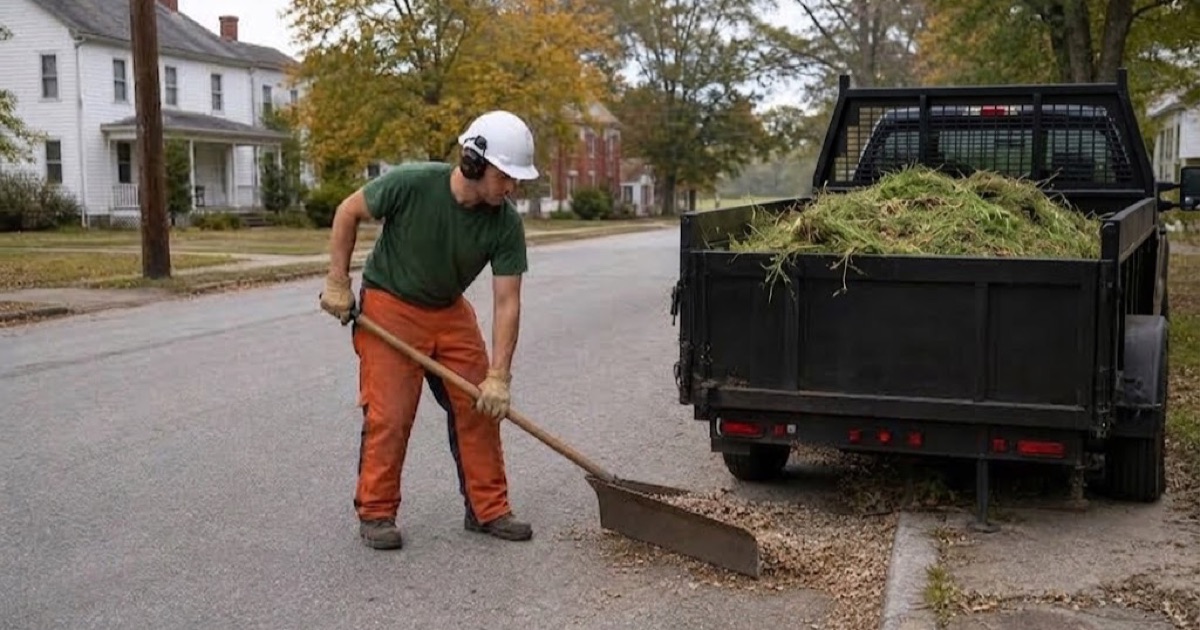
Section 17-111, added by Ordinance #16-13 in August 2016, is unusually direct. The City of Lewisburg collects and disposes of yard waste for individuals, with yard waste defined as brush, trees and bushes, and the same section states that the city will not collect a contractor’s yard waste and that contractors are responsible for the disposal of their own. A bid that quietly leaves the wood at the curb is leaving a homeowner with a pile the city has already declined.
The section limits what pickup can do even for a homeowner. Items have to be cut in lengths not exceeding eight feet, leaves, twigs, small branches and pine cones have to be bagged, and everything must sit at or near the right-of-way where it can be reached from the roadway, because city crews will not enter private property. Stumps and trees pushed to the right-of-way that require mechanical means such as dozers or loaders will not be picked up at all, and that is precisely the heavy end of a removal.
Where a contractor’s load actually goes
Section 17-108 closes the loop, expressly prohibiting the disposal of refuse in any quantity, by any person, in any place public or private, other than at a site designated for refuse disposal by the city council. There is no informal back-lot option in this city, and we would not use one anyway.
Cedar Ridge Landfill, a WM facility at 2340 Mooresville Highway, sits inside the city limits. It is a 142-acre disposal facility permitted through the Tennessee Department of Environment and Conservation, taking yard waste and green waste along with construction and demolition debris, open Monday through Friday from 6:00 a.m. to 4:00 p.m. and closed weekends. A late Friday removal is a Monday haul, and we schedule around the gate rather than discover it there.
Marshall County Solid Waste operates from 611 Hawkins Drive and runs four rural convenience centers. Those centers exclude commercial and business waste outright, so a contractor’s load cannot be taken to one. Anyone comparing bids here is entitled to ask where the wood is going, because that answer is what the disposal line on the estimate is actually paying for.
The wind this city was surveyed for, and licensing stated plainly
The documented load case here is straight-line wind
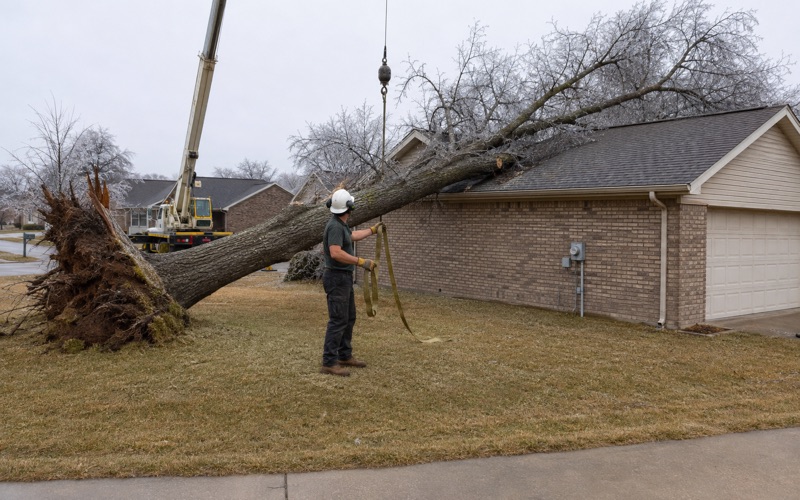
On March 9, 2017 the National Weather Service surveyed a 12-mile straight-line wind damage path at Lewisburg, with winds generally 75 to 80 mph and a peak of 90 to 95 mph. The survey recorded dozens of trees snapped and uprooted along with minor roof damage to several homes, including a concentrated area where an entire metal roof was blown off. The same survey rated a separate EF-0 tornado near Belfast in Marshall County, a 3.1-mile path 100 yards at its widest with an estimated peak wind of 80 mph.
Uprooting rather than stem failure is the part of that record worth reading. Thin clayey residuum over limestone gives a tree a wide, shallow root plate instead of depth, and saturated ground under a strong wind lifts the plate whole. When we assess a leaning tree here we look at the root flare and at the ground on the windward side, not only at the trunk.
What that does to scheduling
Storm work moves ahead of planned work, and the code anticipates it. Section 17-111 allows its brush rules to be relaxed during emergencies, naming ice storms, tornadoes and high winds, and the stormwater ordinance exempts emergency activity outright. When a booked removal has to move for a storm week, we say so when we book it rather than on the morning it slips.
Licensing in Marshall County
Tennessee issues no trade-specific tree care or arborist license, and we would rather state that plainly than let it be implied. The state contractor license under T.C.A. 62-6-501 applies at $25,000 or more in materials and labor. The county-option Home Improvement license has been adopted in nine Tennessee counties and Marshall is not among them, so it does not reach work in this city.
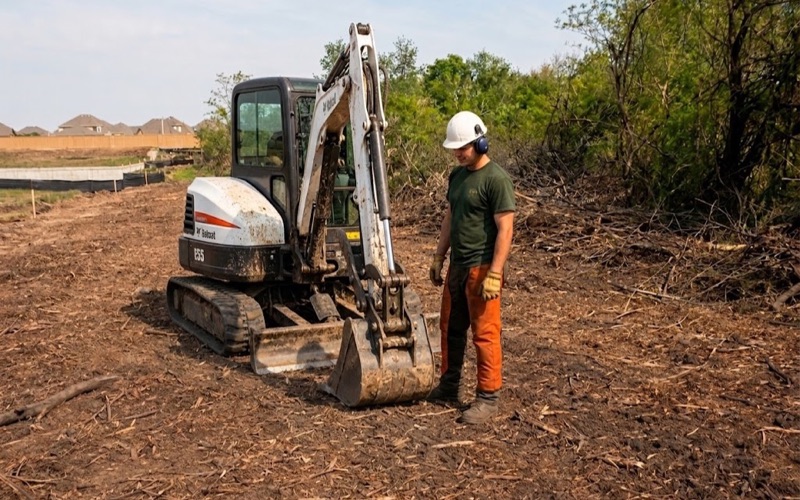
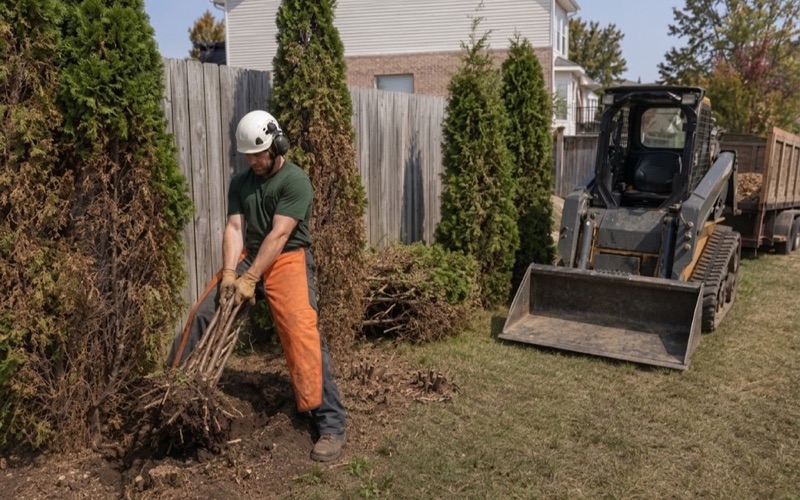
What is left to judge a company on is the work and the paperwork it hands over. We write tree condition reports a homeowner can give to a neighbor, an insurer or an HOA architectural review committee, we run compact tracked equipment that fits through a back-yard gate, and we will tell you when a tree is worth keeping rather than removing.
- 20+ Years in Middle Tennessee
- Free Estimates
- Written Scope Before Work Starts