Spring Hill Tree Removal has been handling tree removal in La Vergne and across Middle Tennessee for more than twenty years, and the first thing we check on a job here is not the tree but the paperwork attached to the ground it stands on. The city asks nothing of a private owner who wants a tree taken down. What it does have is a landscaping chapter that keeps working long after a certificate of occupancy is issued.
That distinction decides whether a removal is a straightforward day of work or a decision with a replanting bill behind it. If the trunk was counted toward an approved landscape plan, taking it out obligates someone to put a tree back, and a required screening tree that has been topped is treated the same way. Neither outcome is obvious from the curb.
So we read the ordinance for the address before we quote, put the inclusions in writing, and say plainly when a tree can be pruned, cabled or braced instead of removed. Estimates are free, and sometimes the answer is that the tree stays.
Does La Vergne make you get a permit first?
No — the city’s zoning ordinance sets no permit requirement and no trunk-size trigger for removing an existing tree on private property. Chapter 9, the landscaping chapter, was read end to end, and its compliance review is triggered only at the submittal of development plans, site plans and preliminary plats. The planting requirements in section 9.3 apply to non-residential development.
That is not the same as a city with nothing to say about trees. The same chapter asks for one canopy tree of 2.5 inch caliper, or two understory trees of 1.5 inch caliper, per 25 feet of road frontage; three canopy trees per 100 linear feet of parking perimeter; and six large maturing trees with 40 shrubs per 100 linear feet of landscape screen. It closes with a two-page Tree Specification List. The chapter regulates trees in detail and still asks nothing of a homeowner clearing one out of a back yard.
Cite the 2025 ordinance, not the one before it
The ordinance now in force is new. It was recommended by the Municipal Planning Commission on July 29, 2025, adopted by the Board of Mayor and Aldermen on October 9, 2025, and became effective October 21, 2025. Advice written from an older version of the code is stale, and the provisions worth knowing are cited by chapter and section rather than by an online code node.
The rule that does reach a private tree
The City of La Vergne Municipal Code, Title 13 Property Maintenance Regulations, prohibits an owner from creating, maintaining or permitting the growth of trees, vines, grass and underbrush, or accumulations of debris, in a manner that endangers the health, safety or welfare of other citizens. A dead or failing tree leaning toward the next lot is reached there, through property maintenance rather than through any removal approval. When that is the situation, we write up what we found in a tree condition report you can hand to a neighbor, an insurer or an architectural review committee.
Most calls here are that kind of call rather than a code question. We look at the root flare, at co-dominant stems and included bark, at a conk at the base, and at what stands under the tree if it fails, and then we say whether the honest answer is removal, deadwooding and crown cleaning, or a cable. Nothing in the city’s rules changes that assessment on a private lot; it only changes what has to happen afterward.
Looking for tree service closer to Murfreesboro? See Tree Service in Murfreesboro.
The question that actually matters: is the tree on an approved plan?
Section 9.4.4(E) is short and consequential. Plant material shown on an approved landscape plan must be replaced if it dies, is seriously damaged, or is removed. A tree counted toward a required screen, buffer, frontage or parking-perimeter planting is not simply yours to subtract, and taking it out creates a replanting obligation even though nothing in the chapter asks you to apply first.
So the opening question on a commercial site, an apartment property or a subdivision common area is whether a landscape plan sits on file with the city and whether this trunk appears on it. Where it does, the removal and the replacement are one job and should be quoted as one job. Where it does not — a volunteer hackberry in a side yard, a redcedar behind a fence — the obligation never attaches and the work is simply the work.
Finding out is not usually hard. The Planning Director and the Municipal Planning Commission are the reviewers of record for landscape plans, and the Planning Director also holds approval authority over counting existing vegetation toward a required landscape screen under section 9.3.2(D)(3). If mature trees standing on the site were credited that way when the property was approved, they are required trees now, whatever they look like in a fence line.
Topping a required tree is a replacement bill
Section 9.4.4(G) requires that screening and buffer trees be maintained in their characteristic natural shape, and that they not be severely pruned, sheared or topped. A required tree treated that way is deemed damaged vegetation and must be replaced within one year. That turns topping from an argument about good practice into a line item with a deadline attached to it.
We do not top trees, and on a required planting the ordinance now says so in writing too. Crown cleaning, crown raising, crown thinning and crown reduction are four different operations with four different objectives, and we work them to the objectives and cut types the ANSI A300 pruning standard defines. On co-dominant stems with included bark, cabling and bracing is frequently the honest answer instead of shortening a leader.
Corner lots and how high the crown comes up
Section 9.4.1(F) allows no plants in a sight distance triangle at an intersection or driveway unless an unobstructed view between 30 and 72 inches in height is maintained. On a corner lot that is what actually sets the crown-raising height. It is worth settling before the saw comes out rather than after.
Warranty, bond, and who carries the replacement planting
Section 9.4.1(B) puts a 24-month warranty on new required plant material, carried by the installing contractor, with a maintenance bond submitted to the Planning Director. That is the local expectation for who holds the risk on a replacement tree through its first two growing seasons. It belongs in the conversation before anyone agrees on who is doing the planting.
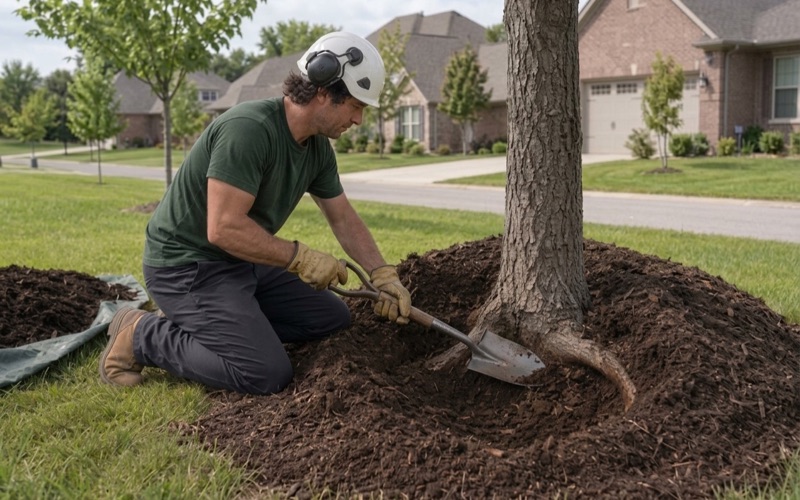
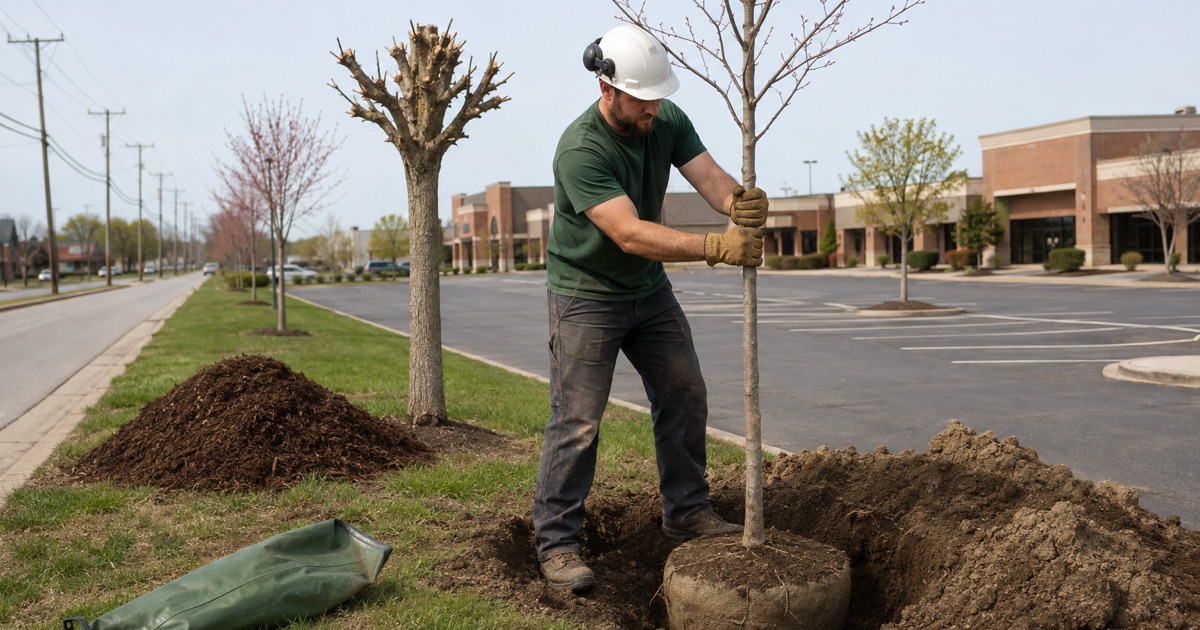
The same section set is specific about installation: under section 9.4.1(D), trees are guyed or staked and mulched in a 3 to 4 inch layer so wind cannot loosen the roots. Those are small requirements that decide whether a warranted tree lives long enough to come off warranty.
What we put in writing before we start
We name the inclusions up front — the trunk rounds, the stump, the grindings and the chips — because the disagreement at the end of a job is almost always about one of those four. Where an approved plan is involved, the same document says whether our price covers the replacement planting or stops at the removal.
Access, equipment and the call before anyone digs
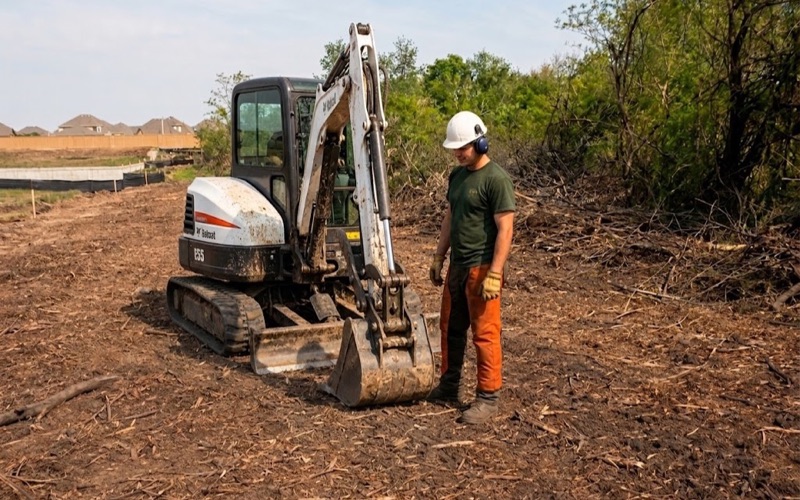
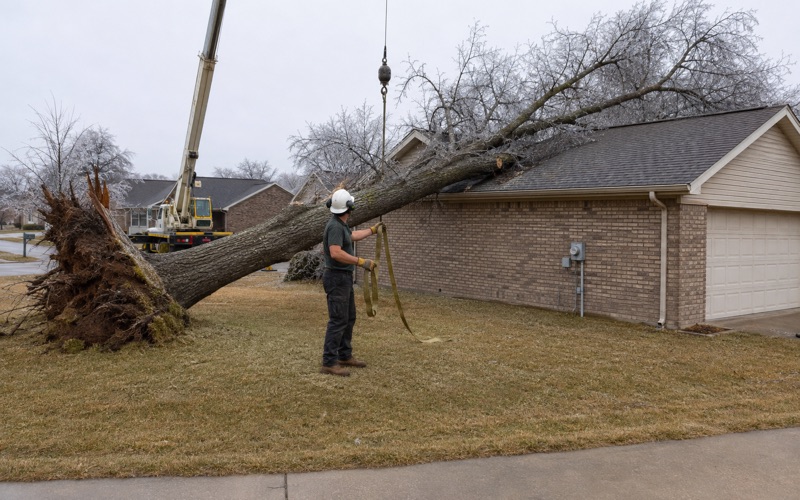
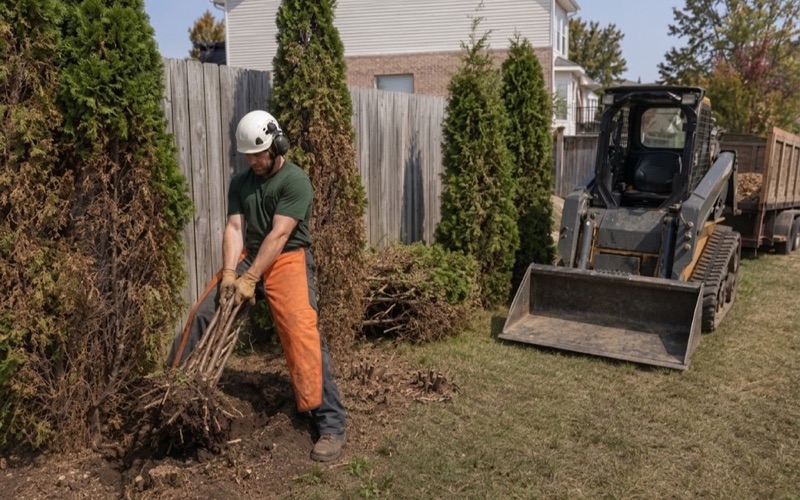
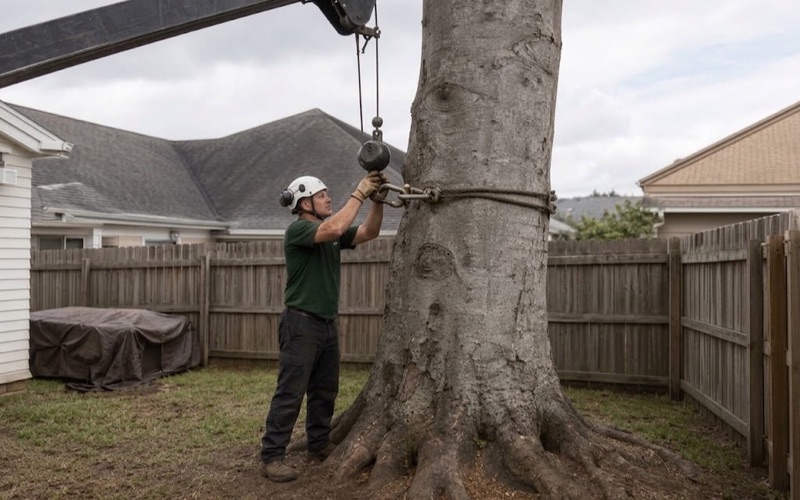
Compact tracked equipment fits through a back-yard gate, so a subdivision tree in a neighborhood like Lake Forest Estates does not have to become a crane job. When a mature canopy genuinely needs one, we have the crane and rigging capacity for it. On a commercial lot the constraint is different again: perimeter planting strips and landscape islands, not open lawn, decide where a chipper and a lowering point can go.
Any digging begins with the mandatory Notice of Intent to Excavate filed with Tennessee 811, which reaches stump grinding and root excavation as squarely as it reaches planting a replacement tree. That call is not optional and it is not ours to skip because a hole looks shallow.
One more piece of paperwork is worth stating plainly, because it is often misrepresented: Tennessee issues no tree care or arborist license of any kind. The state contractor license applies to work of 25,000 dollars or more, and Rutherford County is one of the nine counties that adopted the Home Improvement Contractor requirement for residential work from 3,000 to 24,999 dollars, with 10,000 dollars in financial responsibility posted. The statutory definition of home improvement expressly includes landscaping.
Overhead lines, height overlays, and what goes back in the hole
Where large maturing trees would otherwise be required and overhead utility lines exist, section 9.4.1(G) substitutes small maturing trees at one per 30 linear feet, with the approval of the Planning Director. It is a practical provision, because the city has already decided what a compliant planting under a line looks like. A replacement under wire does not have to become an argument.
We check which electric utility serves an address before quoting anything near a conductor, rather than assuming. Middle Tennessee Electric’s cleared right of way runs 40 feet wide, 20 feet on each side of the line, and its crews cut back or eventually remove trees standing inside it; Vegetation Management can be reached at 1-877-414-7685. For underground equipment, MTE’s No Grow Zone leaves 12 feet clear in front of a transformer and 3 feet on every other side.
Two airports and the height they impose
Sections 12.5 and 12.6 of the zoning ordinance carry height zoning overlays for the approach surfaces of Smyrna Airport and Nashville International. On an affected parcel those surfaces can cap how tall a mature tree is permitted to become, independently of anything the landscaping chapter requires. That makes species selection a compliance question there and not only a matter of taste, and it is cheaper to raise before replanting than fifteen years after.
Choosing what replaces it
La Vergne’s approved canopy tree list in Table 9.2 still includes two Callery pear cultivars, listed as Aristocrat pear and Cleveland Select Pear. Nothing prohibits them and we will not pretend otherwise. The argument against them here is structural: the branch attachments fail under ice and wind loading, which is a poor trade in a tree that has to satisfy a plan for decades.
The species that hold up are largely the ones this ground already grows. La Vergne sits in the Inner Nashville Basin, EPA Level IV ecoregion 71i, on flat-lying Ordovician limestone, where post oak, chinkapin oak and eastern redcedar dominate, with winged elm, blue ash, redbud and hackberry alongside them. Matching a replacement to that vocabulary is how a required tree reaches maturity in the characteristic natural shape section 9.4.4(G) asks for.
- 20+ Years in Middle Tennessee
- Free Estimates
- Written Scope Before Work Starts