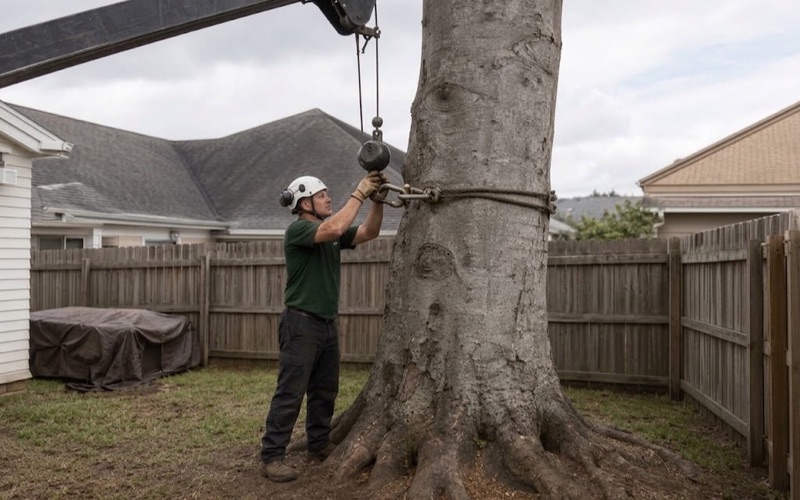
Spring Hill Tree Removal has handled tree removal in Franklin for more than twenty years, and the first thing we settle on a Franklin property is not the drop zone or the rigging plan. It is whether the tree is a specimen tree, because that one answer changes what is legal here, what the work costs, and how long it takes to get to it.
Franklin protects specimen trees under its Zoning Ordinance, Chapter 17 Natural Resources, Section 17.2 Tree Protection, in the edition effective July 1, 2024. A specimen tree is not protected because of the lot it happens to stand on. The protection belongs to the tree, and it holds where the ordinary residential exemptions would otherwise apply.
We read the ordinance for the city a tree actually stands in rather than carrying over what was true one town north, and we say at the estimate whether a removal is straightforward, whether it needs an exemption, and what replacement it will trigger. Estimates are free, and the answer is the same whether it is the one you were hoping for or not.
The One Class of Tree Franklin Will Not Let You Take
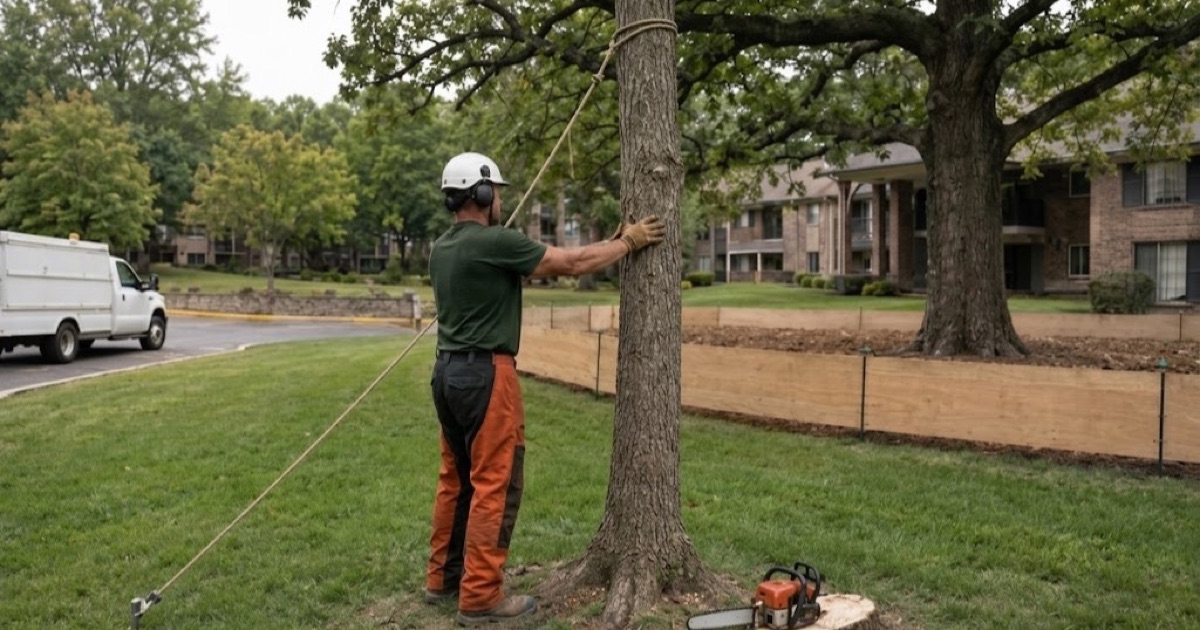
The ordinance language on specimen trees is flat rather than procedural: a specimen tree shall not be cut, removed, pushed over, killed or otherwise harmed except by exemption. There is no application that trades one for a fee, and no version of the job where the tree comes down first and the paperwork catches up later.
Harmed Is a Wider Word Than Removed
Most people read that sentence as a rule about felling. It is broader than that: pushing a tree over with a machine, grading or filling over its roots, and killing it slowly through damage it never visibly recovers from all sit inside the same prohibition.
Franklin also writes excessive pruning and tree topping into the ordinance as violations requiring mitigation, not as poor practice a neighbor might grumble about. We work pruning to the objectives and cut types the ANSI A300 standard defines and we do not top trees, which on a protected Franklin tree is a code question before it is a horticultural one.
Franklin Has Been Doing This a Long Time
The instinct behind the ordinance is older than the ordinance. The Arboretum at Old Town, on a 43-acre historical and archaeological site in the city, presents 75 species of native and ornamental trees and holds the Old Town Bur Oak, designated a Landmark Tree by the Tennessee Urban Forestry Council. Chapter 17 is that same regard for individual trees written down and made enforceable on private property.
Who Decides, and When
Whether a particular tree carries the designation is the city’s determination, not ours and not a homeowner’s. The Department of Planning and Sustainability and the City arborist review a removal application, and the Department of Building and Neighborhood Services at 615-794-7012 issues or refuses the permit that follows.
That sequencing reaches construction too. No building permit or grading permit is released until tree removal compliance or an exemption is documented, so on a Franklin addition, pool or new driveway the tree question is not a late item that can be sorted out while an excavator sits on the clock.
When a tree turns out to be protected, the useful conversation is what can legally be done to it instead. Crown cleaning, deadwooding, a measured crown reduction, or cabling and bracing across co-dominant stems with included bark are all real answers, and we will say when one of them is a genuine alternative to removal rather than a way of putting the decision off a year.
Looking for tree-removal closer to Brentwood? See Tree-Removal in Brentwood.
Critical Root Zones and the Lot Designation That Follows the Property
Leaving a specimen tree standing is not by itself compliance. Work inside its critical root zone, meaning a trench, a footing, a utility run, regrading, or equipment parked on the ground above the roots, requires documentation from an ISA Certified Arborist that no harm will result to the tree.
The Credential the Ordinance Names
That requirement carries more weight in Tennessee than it might elsewhere, because the state issues no tree care or arborist license of any kind. There is no state credential to look up. ISA certification is what this ordinance names for critical root zone work and what the Tennessee Division of Forestry recommends, which makes it the thing a Franklin property owner can actually verify on whoever signs a document.
We are careful about which piece of paper is which. Our written tree condition reports set out what we found and why we would do the work a particular way, in language you can hand to a neighbor, an insurer or an HOA architectural review committee. Where the ordinance calls for documentation from an ISA Certified Arborist, that is a specific credential the city names, and it should be confirmed on whoever provides it.
Critical Lots on the Final Plat
An individual residential lot holding a specimen tree is designated a critical lot on the final plat. The designation is recorded against the property rather than agreed with the owner, so it survives a sale, and a buyer who never read a plat can own one without knowing it.
It also has teeth on a small property. A single-family lot of one acre or less that would otherwise sit outside these standards loses that exemption when it is a critical lot, so two neighbors with identically sized lots can be in genuinely different positions because one of them has a protected tree in the back corner.
That is worth establishing before a project is priced rather than after the concrete is ordered. Where roots and a planned improvement are going to meet, root collar excavation with an air spade to see what is actually under the flare is a less destructive first move than a trencher and an optimistic assumption.
Mitigation: Two Caliper Inches Back for Every Inch Removed
When a specimen tree is removed or damaged, Franklin mitigates it at two caliper inches of replacement for every caliper inch removed. Each replacement tree has to be at least two caliper inches, and the planting has to happen within twelve months.
That ratio is the part that surprises people. A twenty-four inch specimen is forty-eight caliper inches of replacement, and at the two-inch minimum that is a great many young trees to find room for on an ordinary residential lot.
The City Tree Bank When the Ground Runs Out
The ordinance anticipates that problem. Where there is no room on site, a cash payment into the City tree bank is allowed in place of planting, and Franklin’s Tree Commission counts planning the use of tree bank funds among its duties. Either way the obligation gets closed out deliberately instead of drifting.
Protected Trees That Are Not Specimens
Trees removed from a protected area that are not specimen trees are replaced one caliper inch to one caliper inch, the same idea at half the rate. Where the extent of removal cannot be determined, the standard is replanting at eighty trees per acre for each acre disturbed or portion of one, which is the ordinance’s answer to ground that was cleared before anybody measured what stood on it.
The Dead, Dying and Structurally Unsound Route
Section 17.2.1 exempts a tree the Department of Planning and Sustainability determines to be unhealthy, or one carrying written verification of a dead, dying or structurally unsound condition prepared by a certified arborist. Nuisance trees, trees threatening an existing structure, an underground utility or public safety, trees encroaching a utility easement, and removals during weather-related emergencies and natural disasters are exempt as well.
That is the route most distress calls travel down. A conk at the base, a split at a co-dominant union, a root plate lifting on the windward side after a saturated week: those are findings, and we write down what we see, with the diameter at breast height and the location of the defect. Whether a finding becomes an exemption is Franklin’s call on Franklin’s paperwork, and we would rather present it cleanly than argue it after the fact.
Multifamily, Commercial and Institutional Grounds in Franklin
Franklin is not only single-family lots. Of 36,239 housing units in the city, 28.8 percent sit in buildings of five or more units, and 2,762 renter households are in structures of fifty or more. That is a substantial amount of landscape held by property managers, associations and institutions rather than individual owners.
On a commercial, industrial or multifamily lot a tree removal permit is required for a removal of any size, with no relief for a small parcel. The recommendation of approval, approval with conditions or denial comes out of the planning review before the permit itself is issued.
Work Planned Around People Who Live There
A removal on an occupied property is a scheduling problem as much as a technical one. Fire lanes, resident parking and a canopy sitting directly over cars mean the drop zone has to be agreed before the crew arrives, and the ordinance question has to be closed before that.
We put the inclusions in writing before anything starts: the trunk rounds, the stump, the grindings and the chips, and who ends up with each of them. On a managed property that line is usually the one that gets queried later, so it is better settled in the estimate.
Where the Wood Goes
Disposal is a real cost line rather than an afterthought. The Williamson County Landfill at 5750 Pinewood Road carries a Franklin address and takes brush at $40.00 per ton, with Class I and Class III/IV waste at $75.00 per ton, so the volume coming off a large removal is a number that can be worked out in advance.
For a homeowner handling their own cleanup, the city collects brush placed at the edge of the street inside its right-of-way, cut no longer than six feet and stacked end to end rather than tangled, kept clear of mailboxes, water meters, utility boxes and parked cars. Sanitation and Environmental Services is at 615-794-1516, and after a major storm the city suspends its usual excess brush limits.
Two decades and more of tree work across Middle Tennessee have taught us that the part of a Franklin removal a homeowner cannot see from the driveway is usually the ordinance, not the tree. We look it up for the address in question, we tell you what it says, and the estimate costs nothing either way.
- 20+ Years in Middle Tennessee
- Free Estimates
- Written Scope Before Work Starts