Spring Hill Tree Removal has worked tree removal in Forest Hills for more than twenty years, and here the first question is never which way the tree falls. It is whether the removal has been approved at all. A healthy tree in an established yard is a permit question in this city before it is a saw question.
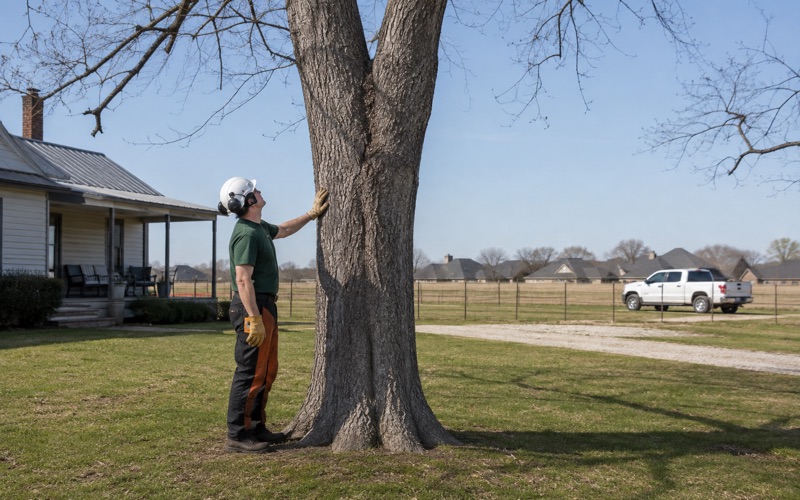
That shapes the first visit. We walk the lot, measure trunks at diameter at breast height, read condition, and tell you which trees can come down this week and which need an approved application first. The owner of a tree already lying across the drive gets a different answer than the owner of a leaning oak still standing.
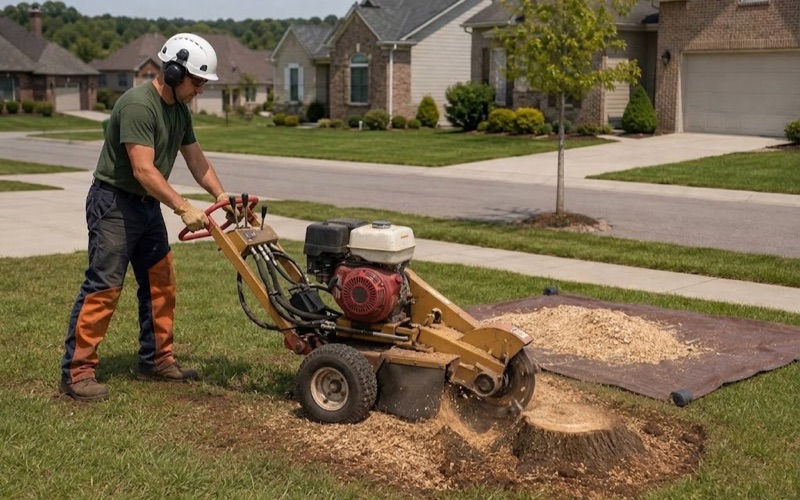
Estimates are free, and the inclusions go in writing before we start: trunk rounds, stump, grindings and chips. If a tree can be cabled, braced or pruned instead of removed, we will say so before you spend money chasing a removal the city may not approve.
What Comes Down Today, and What Waits for an Approved Application
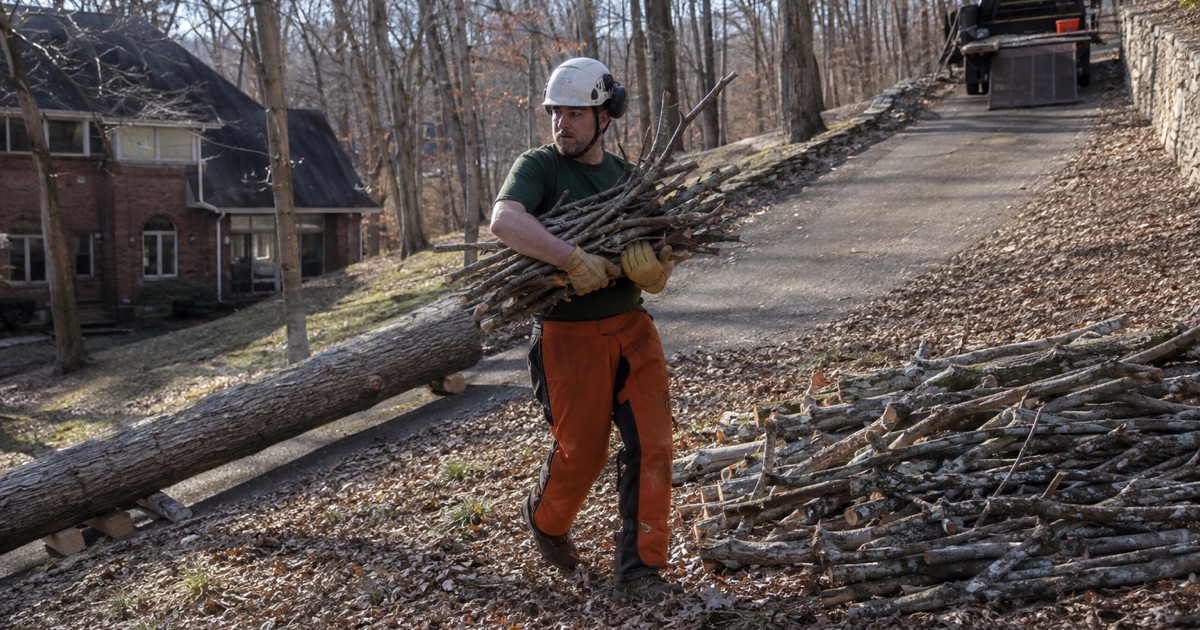
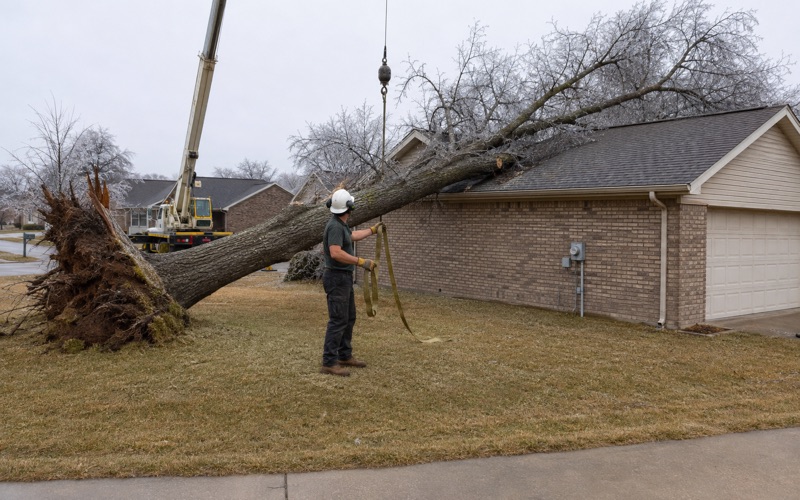
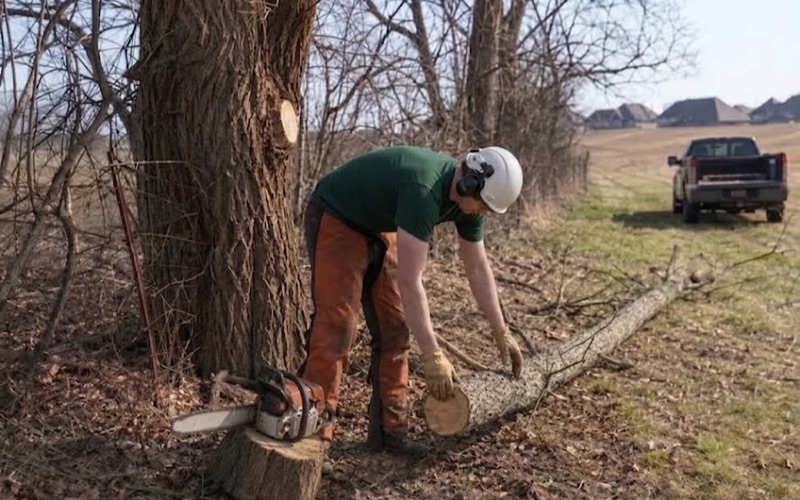
Two removals need no permit in Forest Hills: a dead tree, and a tree that has already fallen due to a storm or another natural occurrence. Those are the exemptions, and they are the entire list. Everything else runs through an application the city approves first, from the healthy tuliptree crowding a foundation to the hickory a buyer wants gone before closing.
That split sets the schedule more than crew size does. A dead tree can be on the truck this week; a living one is a two-step job, and the paperwork is step one.
Forest Hills Answers to Its Own City Hall
When Nashville and Davidson County consolidated their governments in 1963, several smaller satellite cities kept their existing charters and municipal authorities instead of being folded into the metropolitan government. Forest Hills is one of them, run under a manager-commission charter whose Board of Commissioners adopts and administers the city’s own zoning ordinance, tree removal permit included.
That is why advice picked up from Metro Nashville does not survive contact with a yard here. Metro’s tree provisions are aimed at public and right-of-way trees and at development Metro permits, and most single-family owners elsewhere in Davidson County can take a tree off their own land without asking Metro anything. Inside this city the answer belongs to the city, and we read the ordinance for the place the tree actually stands in.
What Section 6.05 Reaches
Section 6.05, Woodland and Tree Protection, sits at Title 14, Chapter 2 of the municipal code and was amended by Ordinance 2021-03. Its standards apply to approval of any newly platted lot, construction of any new residential dwelling, any land disturbance activity requiring a stormwater permit, removal of specimen trees from any lot, and timber harvesting or clearcutting. It binds homeowners and contractors alike, so hiring a crew does not move the obligation off the property.
The application and any tree replacement plan go to the City Manager with the City Arborist, who may be a city agent or an independent Certified Arborist, and no permit issues until conformance is determined; the site is inspected before, during and after the work. Violation of any section carries a fifty dollar fine per day, per violation, until it is remedied. Tennessee issues no trade-specific tree-care or arborist license, so the paperwork that governs your removal is the city’s, not a state trade card.
Looking for tree-removal closer to Oak Hill? See Tree-Removal in Oak Hill.
Specimen Trees, and the Inventory That Remembers
Thirty and Thirty-Six Inches at Breast Height
A specimen tree is any tree in fair or better condition measuring 30 inches or more in diameter at breast height for large hardwoods, or 36 inches or more for large softwoods. Fair or better is defined rather than eyeballed: a life expectancy greater than fifteen years, a structurally sound trunk, and no major insect or pathological problem. A smaller tree can still qualify on historical significance, including a listing on the state Landmark and Historic Tree Registry.
Those thresholds are not theoretical on a lot that has been left wooded. White oak, northern red oak, tuliptree, sugar maple and hickory are the signature hardwoods of the Outer Nashville Basin, and eastern redcedar is the softwood most often measured against the larger number.
Because the size test and the condition test work together, a big tree in decline and a big tree in good health are two different applications. We write up what we find in the trunk and crown, including co-dominant stems, included bark and any conk, in a report you can hand to the city, an insurer, a neighbor or an HOA architectural review committee.
The city’s own position is that healthy native trees are usually not permitted to come out without good reason, and that one which does must be replaced inch for inch with a similar species. When the answer is no, the useful work is pruning, worked to the objectives and cut types the ANSI A300 standard defines. We do not top trees.
Trees That Are Already Gone Still Count
Retention is measured against the lot’s existing tree inventory, and that inventory has a two-year memory. Any tree removed in the last two years and not replaced with a tree of eight inches DBH or greater is counted back into the inventory, whether or not the removal was permitted. A removal done last season shows up in this season’s math, and a buyer inherits the previous owner’s arithmetic along with the deed.
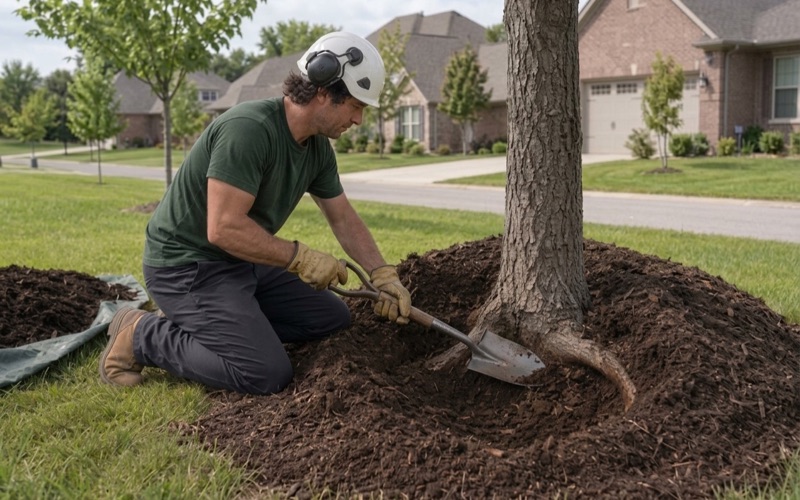
Replacement obligations run on the same logic. Replanting is required at eighty trees per acre disturbed in excess of the retention standards, or as an inch-by-inch caliper replacement, with replacements at least two inches DBH and maintained through an establishment period of at least three years that resets if they do not survive. A survey of all trees on the lot also has to be prepared and submitted before any clearing, removal or land disturbance in excess of 2,500 square feet.
Clearcutting, and the Clause That Suspends the Rest After a Storm
A Three-Year Suspension That Attaches to the Land
Clearcutting and timber harvesting are strictly prohibited here, and the landscaping provisions prohibit clearcutting on any lot a second time for good measure. The ordinance defines it plainly: most or all of the trees on a lot cut down. Where clearcutting occurs, the property takes a three-year suspension of all development approvals, rezoning requests and land disturbance permits, running from the time it happens.
That penalty attaches to the land rather than to whoever ran the saws, which is why we will not take a Forest Hills lot to bare ground however the request is phrased. Clearing the back half is a conversation we have before the first tree comes down, not after the tenth. Selective removal against a retained canopy is the only shape this work takes here.
Section 6.05(j), the Storm Clause
The ordinance carries its own emergency valve: in a natural disaster or other emergency, the City Manager may suspend its provisions where they would prevent, hinder or delay necessary action in coping with the disaster. That clause matters more than anything else in the section during the week a storm has rearranged a neighborhood.
The ice storm of January 24 and 25, 2026 is the local benchmark. Accumulations ran from a glaze to more than half an inch, a quarter to a half inch typical; power went out to as many as 230,000 households across the Nashville area, and more than 37,000 customers were still without it on February 1. This is an ice-loading region, and the failure mode is horizontal limb structure under weight rather than wind.
A tree already on the ground is exempt in any weather, so the clause does its work on the other category: the split leader still standing, the half-shed crown over a driveway. We plan storm response around the ice loading this area records rather than a generic script, and we do not use a storm as cover to take healthy trees that were never at issue.
Working a One- to Two-Acre Wooded Lot
Most residential parcels here run one to two acres, and the housing stock fills in the rest: single-family attached housing is 0.0 percent of it, and 26.8 percent of units were built before 1960, in the 2020-2024 American Community Survey five-year estimates, tables B25024 and B25034. Every house stands alone inside its own canopy. That removes the shared-wall problem and replaces it with a long drive, a mature crown and a target sitting directly underneath.
Rigging, Crane and What Fits Through the Gate
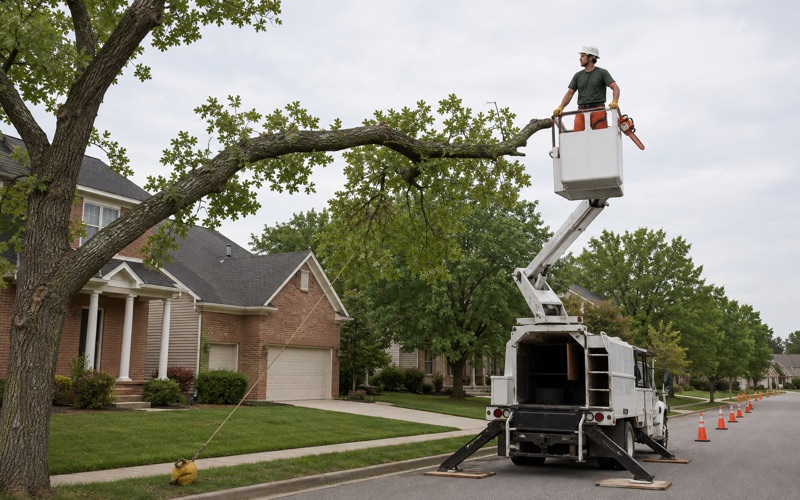
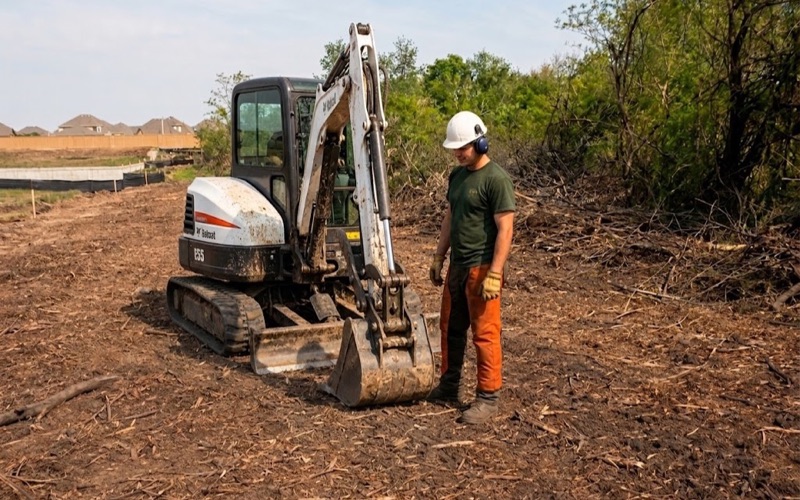
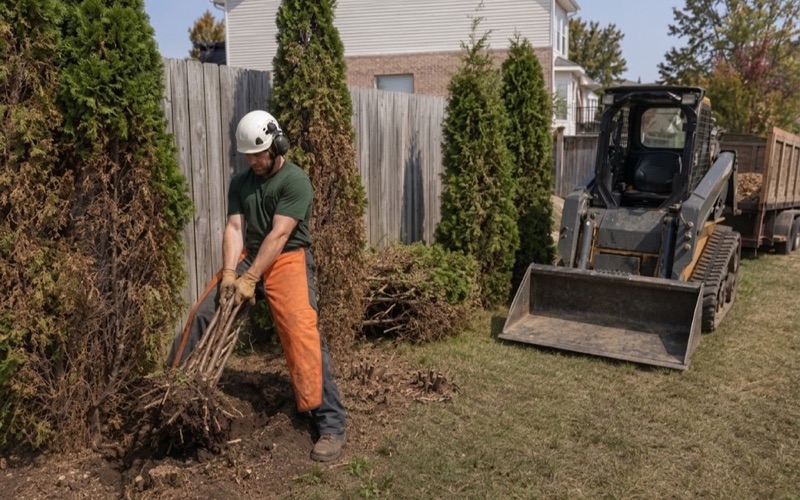
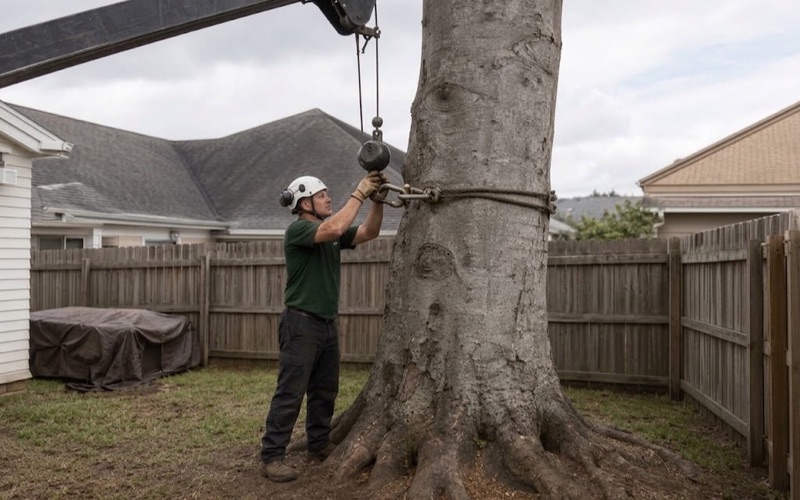
Compact tracked equipment goes through a back-yard gate, so a tree behind the house does not automatically become a crane job. When the crown is too large or the drop zone too tight for that, we have the crane and rigging capacity, and the pieces come down on a bull rope through a rigging block to a friction lowering device, inside the working load limits of the gear rather than at the edge of them. Tree protection fencing outside the root plate keeps machine traffic off the trees the permit is counting on.
Access has one more constraint written into the code. Water quality buffer areas run twenty-five feet perpendicular from each edge of a floodway or floodplain, thirty feet from the top of bank of a wet weather conveyance or other surface water, and sixty feet around a pond or lake. The Otter Creek watershed crosses the south-central part of the city, and reaching a tree inside one of those buffers is a separate question from the removal permit.
Chert, Clay and What the Stump Costs
Bodine is the most extensive soil series mapped in Davidson County by acreage, mapped there at 20 to 50 percent slopes, formed in colluvium or residuum weathered from cherty limestone with more than five feet to bedrock and 35 to 80 percent chert rock fragments through the particle-size control section. A root plate in that material is deep but poorly anchored in loose rock, and the chert destroys a grinder wheel long before bedrock is anywhere near the surface. Lower down the material is clayey limestone residuum: Mimosa, well drained but slowly permeable at 40 to 60 inches to rock, and Talbott shallower still at 20 to 40 inches.
About 81 percent of Davidson County soils are rated very limited for septic absorption fields, shallow bedrock among the reasons, and the same constraint decides whether a stump is ground out or dug. It also explains the windthrow we get called to: a wide, shallow root plate spread over weathered rock, saturated after a long rain, on a slope, under a full crown.
Before We Quote Anything Near a Line
Nashville Electric Service runs the distribution system serving these addresses, and we confirm which utility is on the pole before quoting work near a conductor. After the January storm NES widened its cleared zone from ten feet below the lines to fifteen feet for all tree species, in a horseshoe pattern, and stopped ground-to-sky trimming, leaving lower vegetation in place where it could.
Metro Council urged NES by resolution to pause that blanket fifteen-foot rule; NES declined at its board meeting, saying the risk posed by overgrown trees ahead of severe weather season outweighed the frustration, and reported trimming 587 miles of vegetation between July and December 2025. The program is going ahead, and utility clearance looks nothing like the shape you would prune a yard tree into. It is also a separate matter from the removal we quote and the permit the city reviews.
- 20+ Years in Middle Tennessee
- Free Estimates
- Written Scope Before Work Starts