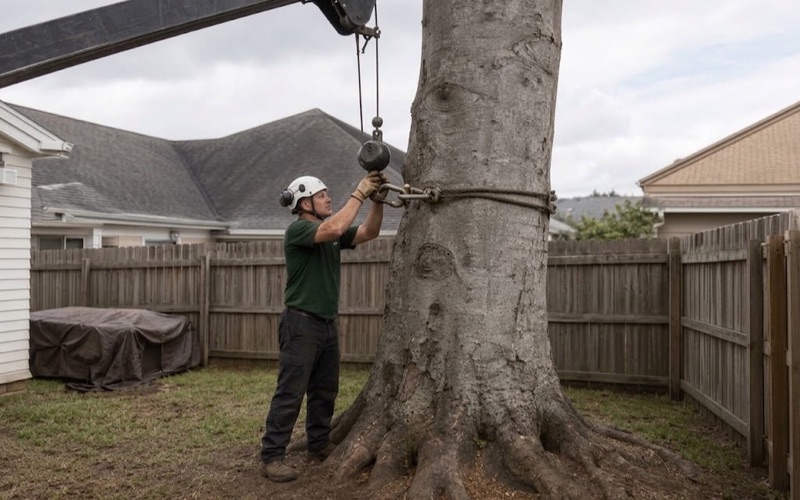
Spring Hill Tree Removal has handled tree removal in Brentwood for more than twenty years, and on most properties here the job is settled before a saw ever runs. The trees are large, they stand over houses, and what sets the price and the schedule is where a machine can be placed and what it will be standing on.
Almost every removal we quote in this city is a rigging problem rather than a felling problem. There is rarely a direction to drop a full stem that does not cross a roof, a pool, a drive or a septic field, so the tree comes down in pieces on a rope or a hook. That sequence has to exist on paper before a crew arrives.
So that is what we price: the crane or lift position, the ground protection under it, the rigging plan, and the inclusions written down in advance, meaning the trunk rounds, the stump, the grindings and the chips. We also read the tree ordinance for the city the tree actually stands in, because what needs permission, and who grants it, changes from one Middle Tennessee municipality to the next.
Big Trees Over Big Houses
Brentwood zones a large residential lot, and that shows up in every quote we write. Sections 78-144(1) and 78-164(1) of the city code set a minimum lot area of two acres in R-1 and one acre in R-2, so the typical parcel is wide, wooded and privately owned from the street to the back line. Nothing is common area, and the canopy over the house belongs to the person paying for the work.
The housing stock matches the zoning. Of the city’s 15,557 housing units, 87.8 percent are single-family detached, and 95.9 percent of owner-occupied units are detached houses, according to the 2020-2024 five-year American Community Survey tables B25024, B25003 and B25032. Renting here mostly means an apartment rather than a house with a yard, since 790 of the 1,420 renter households occupy structures of 50 or more units and only 331 rent a single-family detached house. The person who decides about the tree is almost always the person who owns the ground it stands in.
Trees planted with the house, now at full height
About 38.8 percent of that housing was built before 1990, spread almost evenly across three decades: 15.5 percent in the 1970s, 16.5 percent in the 1980s and 18.5 percent in the 1990s, with the median unit falling in the 1990-1999 band (ACS table B25034). The landscape trees that went in with those houses have had thirty to fifty years to grow.
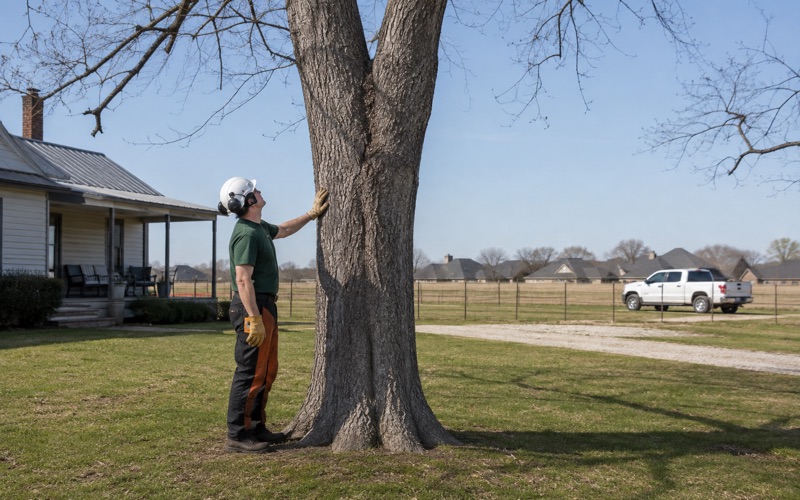
A tulip poplar or white oak set twenty feet off a foundation in 1978 is now a full-height tree with its crown over the roofline and its root plate under the driveway. That is the removal we are usually called for. It is not a hazard tree standing in a woodlot, but a healthy or slowly declining specimen that has outgrown the spot somebody chose for it.
What we look at before we quote a removal
The questions that matter on a tree that size are structural. Co-dominant stems with included bark at the union, a conk at the root flare, a lean that developed after a wet year, deadwood hanging over a walkway: those are the findings that move a tree from monitored to removed.
We write what we find into a tree condition report the homeowner can hand to a neighbor, an insurer or an HOA architectural review committee. We also say plainly when cabling and bracing, or a measured crown reduction, would serve the tree better than taking it down, because the cheapest good outcome is often the one that leaves the tree standing.
Looking for tree-removal closer to Nolensville? See Tree-Removal Services in Nolensville.
Where the Crane Sits, and What the Ground Is Doing Under It
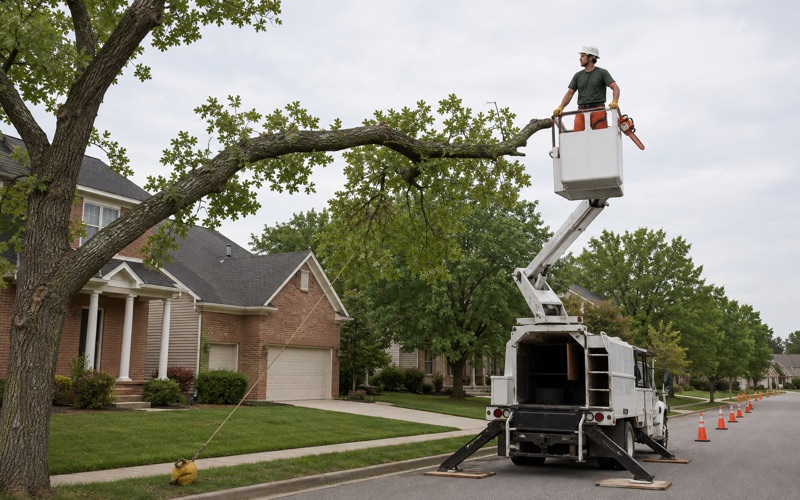
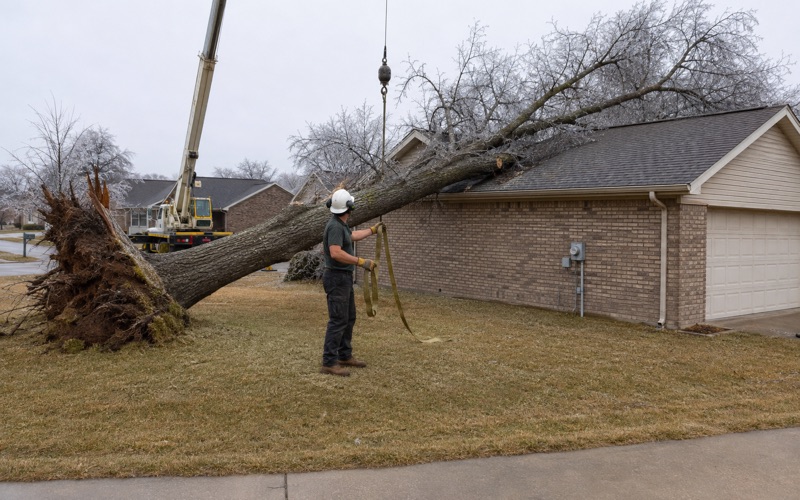
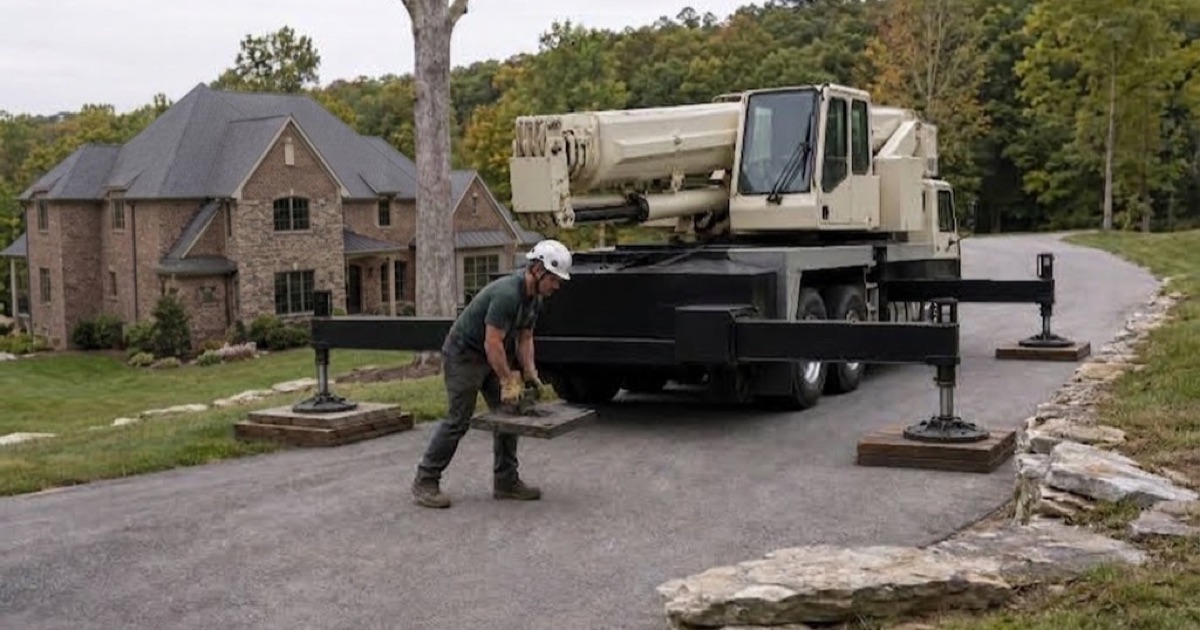
Once a tree is over the house, the whole job turns on machine position. We want a set that reaches the top of the tree with the boom, keeps every load path off the roof, and puts the outriggers on ground that will not move under them. Where all three are possible, the removal is a half day of clean picks; where they are not, the same tree becomes a climb-and-rig job that takes longer and costs more. That difference is decided by the driveway, the grade and the setback rather than by the tree, and it is the first thing we walk.
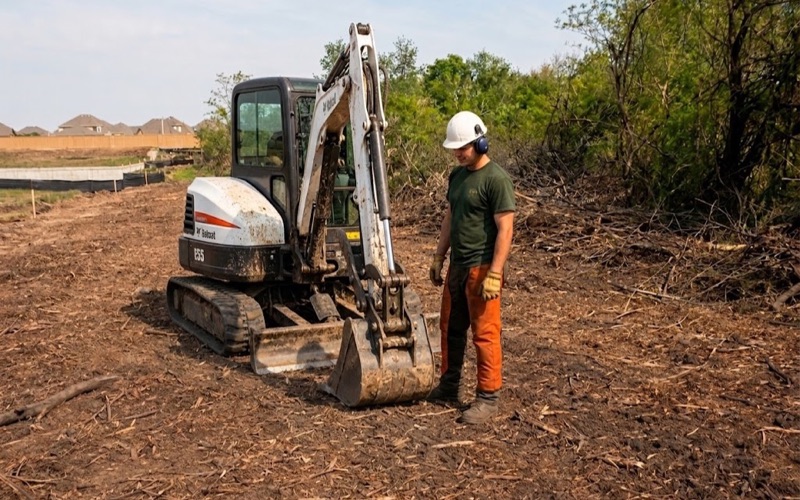
Outrigger footing is the part homeowners rarely expect to hear discussed. Pads go on cribbing or mats, and on turf, a drain field or fresh fill we plan the travel route as carefully as the set, because a position the machine can reach is worthless if getting there wrecks the lawn or collapses a lateral.
Hillside lots and stair-step rock
On sloped ground the footing question gets harder, and Williamson County’s own soil-mapping regulation explains why. It names five common subsurface rock scenarios and calls stair-step or ledge rock the one most typical of hillsides, meaning rock that steps down in shelves instead of lying flat. Across a few feet of travel the bearing under a track or a pad can change from shallow ledge to soft material above a drop.
That same regulation records depth to rock in inches by soil series and defines Rockland as ground where 50 to 90 percent of the surface is exposed rock. Those are per-parcel figures rather than one number for the city, so we probe the intended set instead of assuming a lot behaves the way its neighbor did.
The regulation also separates rock proper, an unweathered bedrock contact, from non-rock horizons such as weathered rock and saprolite, and notes that the Hermitage Formation here is sometimes weathered deeply enough that its limestone bedding planes show above that contact. Weathered rock and hard rock are not the same interface, and a hand probe does not always tell them apart.
When there is no crane position at all
A good number of back yards here have no approach that will take a crane. Those trees come down on rigging instead: a block at a high tie-in point, a friction lowering device at the base, and pieces cut to the working load limit of the system rather than to whatever the climber could saw off.
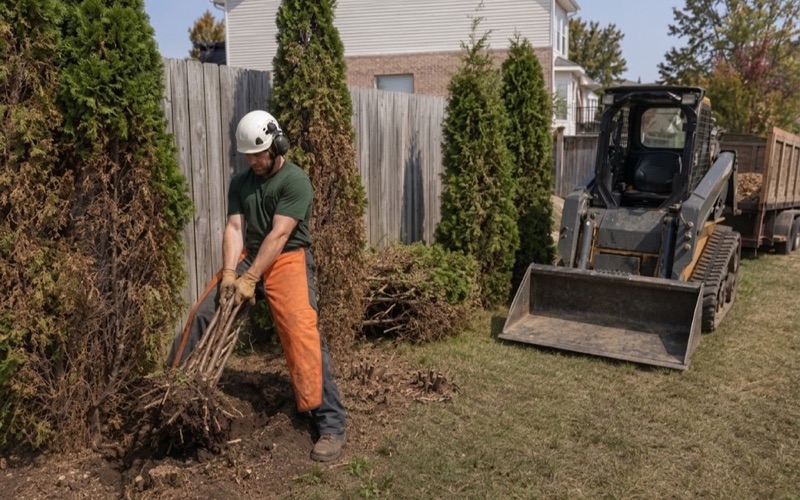
A spider lift gets aerial access on ground a bucket truck cannot work from, and compact tracked equipment keeps the ground pressure down on the way in and out. The rigging plan is the deliverable in that case, and we would rather talk it through with the owner standing in the yard than discover the problem on the morning of the job.
What Brentwood Gates Is the Tree, Not the Lot Size
Removal on private property is regulated here by category rather than by acreage. Section 78-511 of the city code bars removal, without planning commission permission, of a tree designated rare or endangered by a state or federal agency, a tree of historical significance identified by the historic commission, a protected tree of six or more caliper inches deemed significant by the planning commission, and any tree inside a designated protection area within the HP hillside protection overlay district.
Three of those four are determinations somebody has already made about one specific tree, which is the practical point: the answer is not sitting on a diameter tape. We check the category before we quote, and where it is not clear cut, that conversation belongs with the city rather than with a contractor’s guess.
The penalty structure is worth knowing before anyone starts cutting, because each tree removed in violation is a separate offense carrying its own penalty. A crew that clears four trees it had no permission to clear has not made a single mistake.
The hillside protection overlay
The HP hillside protection overlay establishes tree protection areas on hillside property in connection with development or alteration, and removal inside one of those areas needs planning commission approval. It is part of why the steep ground in this city has stayed wooded and privately held rather than being built out, and it is worth confirming before a lot-clearing conversation starts.
Public trees are not the homeowner’s to authorize
Removal of a public tree requires approval of the board of commissioners or its designee. A tree in the strip between sidewalk and curb, or on city park land, sits outside what the adjacent property owner can sign for, however plainly it is the tree causing the damage or dropping the limbs. We establish that at the estimate rather than on the morning of the job, and where the tree turns out to be the city’s we say so instead of quoting work nobody can lawfully authorize.
Who is qualified, and what you can actually verify
Tennessee issues no trade-specific credential for tree care, and the state Home Improvement license regime applies only in counties that adopted it, which Williamson County did not. A state contractor license is required at $25,000 or more in materials and labor, but there is no state credential specific to this trade.
ISA certification is the credential that can actually be checked, and the city’s own code leans on it: an ISA-certified arborist is the person who certifies that protected trees survived a construction project without terminal damage. Ask any company you are considering what it holds, and ask to see it.
Storm Damage, the City Manager Route, and What Leaves the Property
Hazard work runs through a different office than planned removal does. The city manager or a designee may approve removal of a public or private tree that poses a threat to public safety, or that has been substantially harmed by disease, wind, ice or another act of God. That is the provision a storm-damage call sits under, and it moves faster than a planning commission cycle.
Ice load is the failure mode this area actually records. Winter Storm Fern moved through beginning early on Saturday, January 24, 2026, carrying a mixture of snow, sleet and ice; more than 300,000 outages followed across Tennessee, close to 15,000 of them in Williamson County by the end of that weekend, with downed trees and lines blocking county roads.
We plan storm response around that loading pattern rather than a generic script, and we check which utility serves an address before quoting anything near a conductor. Middle Tennessee Electric serves this city, staffs its vegetation management with certified arborists, and keeps a No Grow Zone of 12 feet in front of a pad-mounted transformer and 3 feet clear on its other sides.
Debris, and who hauls it
Brentwood Public Works collects brush once a month from every residential street, running four hydraulic grapple arm trucks in place of its former woodchippers, and asks residents not to pile brush directly under low-hanging limbs so the arm can lift a pile without damaging the tree above it. That service is for material a resident generated.
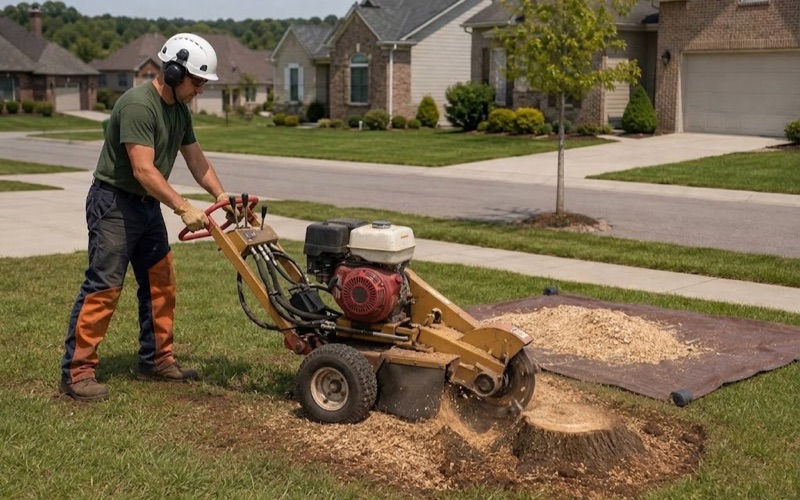
A contractor’s cut is a contractor’s haul. We price disposal into the job rather than leaving a windrow at the curb for the city to deal with, and what stays and what goes is written into the estimate: rounds stacked or removed, chips blown or hauled, grindings left in the hole or carried off.
Pruning instead of removal
Not every call here needs a removal, and we will tell you when yours does not. Where the structure is sound we work to the pruning objectives and cut types the ANSI A300 standard defines, whether that is crown cleaning, crown raising, crown thinning or a measured reduction, and we do not top trees.
The city code prohibits topping outright on public trees and requires ANSI A300 pruning standards on them, which is a reasonable bar to hold a private tree to as well. Estimates are free, and if a job is genuinely worth an insurance claim we will say that too.
- 20+ Years in Middle Tennessee
- Free Estimates
- Written Scope Before Work Starts