
Spring Hill Tree Removal has provided arborist services in Spring Hill, TN for more than twenty years, serving surrounding cities including Thompson’s Station, Columbia, Franklin, Brentwood and Nolensville. An arborist visit is not a sales call with a chainsaw in the truck. It is an inspection with a written outcome: what the tree is, what is wrong with it, what sits underneath it, and what should happen next in what order.
That matters here because Middle Tennessee puts trees under two very different loads. Ice is the local failure case, and the January 2026 storm laid half an inch or more of accretion across the metro. Wind is the other, and on the shallow clay residuum over limestone that covers this part of the Outer Nashville Basin, a tree that cannot root deep spreads a wide flat root plate instead, which lifts as a unit in saturated ground rather than snapping at the stem. Those two mechanisms leave different evidence, and the inspection looks for different things depending on which one you are worried about.
We write the findings down. The report a homeowner receives is meant to be handed to somebody else without translating it first, whether that is an HOA architectural review committee, an adjuster, a builder or the neighbor on the other side of the fence. We also state plainly when the answer is that a tree is fine, because a report that recommends removal every time is not an assessment.
What a Tree Risk Assessment Looks At
Defects, From the Root Flare Upward
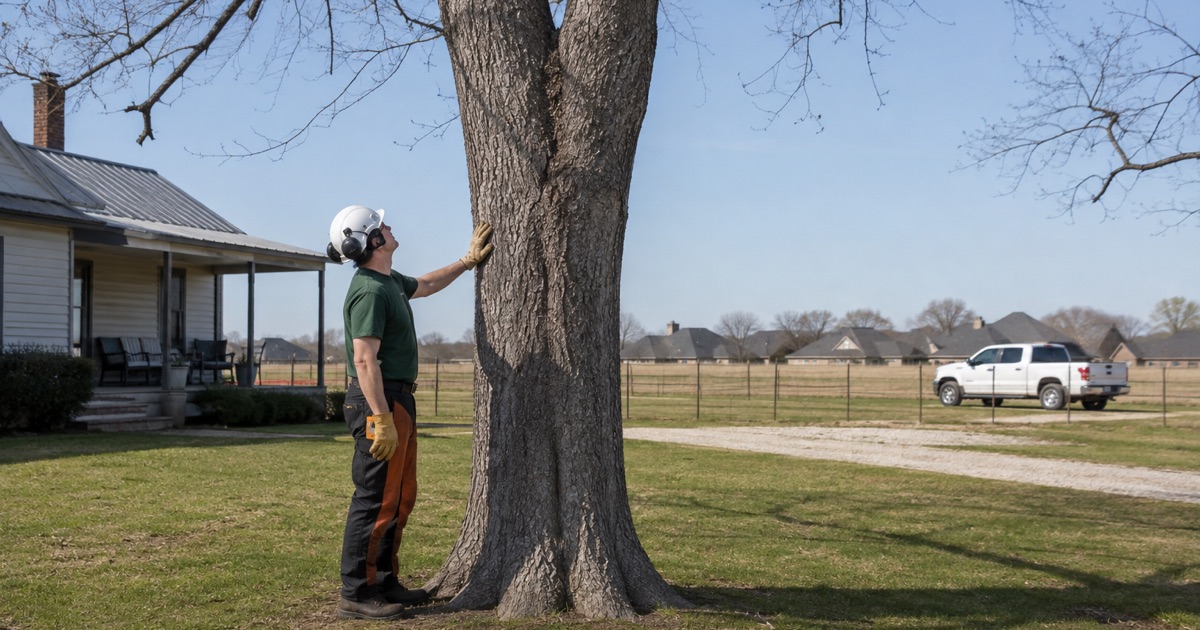
The inspection starts at the ground, because the root flare is where a tree carries everything it weighs into the soil and where the defects that actually kill people tend to sit. We look for a flare buried under mulch or fill, girdling roots, a conk or other fruiting body, cavities, cracks in the buttress, and heaving or cracked soil on the tension side. Above that we read unions rather than diameters: co-dominant stems with included bark, cracks, hangers, deadwood and the reaction growth a tree lays down where it is already under strain.
Targets, and What Sits Underneath
A defect matters in proportion to what it can land on. A hollow silver maple over a fence line at the back of an acre lot is not the same problem as the same tree over a child’s bedroom, and treating them alike is how homeowners end up spending money in the wrong order. We record what occupies the fall zone and how often it is occupied — a driveway used twice a day, a patio used all summer, a road, a shed, a power drop — because that occupancy rate is half of the answer.
The Rating, and the Order the Work Should Happen In
Combining the likelihood of failure, the likelihood of striking the target and the consequence of a strike gives a rating for each tree rather than a single verdict on the property. The value of that is prioritization. Most owners do not do everything at once, and a report that ranks eleven trees so the two urgent ones come out this month and the rest are scheduled over two seasons is more useful than a single number nobody can act on.
Written Reports People Actually Use
Reports for an HOA Architectural Review Committee
Subdivision covenants across this ring commonly route tree removal through an architectural review committee, and committees want documentation rather than a phone call. The report gives them species, diameter at breast height measured four and one-half feet above grade, the condition, the specific defect and the recommendation, in language a volunteer board can read. Because it is written to a standard rather than to the outcome, it works just as well when it supports keeping the tree.
Documentation for an Insurer or an Adjuster
Insurance questions around trees are mostly documentation questions. After a failure, the adjuster wants to know what the tree looked like before it came apart and what part of the cost is debris removal, which most policies cap separately at around $500 per tree and $1,000 per incident. Before a failure, carriers increasingly ask that limbs be cleared off the roof and can non-renew a policy over it. A dated report with photographs answers both conversations.
Notice to a Neighbor About a Hazardous Tree
When the tree causing concern belongs to somebody else, the useful instrument is a written condition report attached to a dated letter. Notice is encouraged rather than required in Tennessee, but once it has been given, the other owner can no longer say the defect was unknown to them. We write to the tree and the target and stay out of the dispute, so the same document reads credibly to a neighbor, an insurer or a court.
The Duty to Inspect, and What Tennessee Expects
The Landowner’s Duty to Inspect
University of Tennessee Extension’s guidance is that an urban Tennessee landowner has a duty to inspect the trees on their premises. In practice that means a defect a reasonable inspection would have found is treated as one the owner knew about, whether or not anybody ever looked. A documented walk of the property is the ordinary way to discharge that duty, and it is bought by owners on both sides of a fence line — one to build knowledge of a problem, the other to show the problem was addressed.
When an Encroaching Tree Crosses Into Nuisance
Tennessee follows the Hawaii Rule under Lane v. W.J. Curry and Sons, which replaced the older self-help-only position. Shade, leaf drop, flowers and fruit are natural conditions rather than a nuisance. What changes the analysis is actual harm or an imminent danger of actual harm — a stem leaning over a roof, a split union above a drive, a dead limb hung above a walkway. Whether a tree has reached that threshold is a condition question, which is exactly what the inspection answers.
Credentials in a State That Licenses Nobody
Tennessee issues no arborist or tree care license, so the letters somebody puts on a truck are voluntary and worth understanding. ISA Certified Arborist standing, a tree risk assessment qualification and Tree Care Industry Association accreditation are industry credentials, not state ones; the state contractor license is a contract-value threshold that starts at $25,000, and the county-option Home Improvement license has been adopted in nine counties, neither Maury nor Williamson among them. Ask any contractor for a certificate of insurance, and read what the report itself says.
Diagnosis Before Anybody Quotes a Removal
Root Collar Excavation and Air Spade Work
When a tree is declining with no visible cause in the crown, the answer is often under the soil. An air spade lifts fill and mulch off the root collar without cutting roots, exposing girdling roots, decay and a flare that has been buried for years. The same tool does soil decompaction and radial trenching where a tree is struggling in the compacted fill left behind by subdivision grading, which is common ground on the newer lots in this market.
Species-Level Decline: Ash, Callery Pear and Leyland Cypress
Some problems are predictable once the species is identified. Emerald ash borer kills the cambium and leaves standing ash brittle enough that it becomes unsafe to climb well before it looks dangerous from the driveway. Callery and Bradford pear split at their crowded, included-bark unions under ice, and Leyland cypress planted as a screen browns out from the interior once the rows close and canker moves in. Naming the species early changes both the recommendation and the method.
Cabling, Bracing and Pruning as Real Alternatives
A defect is not automatically a removal. A co-dominant union can often be supported with a dynamic cabling system in the upper crown, or with extra high strength cable and brace rods through the union itself, and a crown reduction back to sound live laterals can take load off a suspect limb without taking the tree. In this market one hackberry priced at roughly $2,500 to cable against $5,400 to remove. We put both numbers in front of an owner when both are honest options.
Our Step-by-Step Tree Risk Assessment Process
Walk the Property and Inventory What Is There
We start by walking the whole property with you and listing the trees that could reach something if they failed, rather than every stem on the lot. That conversation also surfaces history a tree does not show: a limb that came down two winters ago, grading done during construction, a line trimmed by the utility.
Inspect Each Tree From Flare to Crown
Each listed tree is inspected from the ground up — flare, buttress roots, trunk, unions, scaffold limbs and crown — with the flare sounded and probed where a defect is suspected. Where the view from the ground is not enough, we say so and price a closer look rather than guessing at what is behind the bark.
Rate the Risk Against the Target
Each tree is then rated against what stands underneath it and how often that space is occupied. This is the step that decides the order of the work, and it is also the step that most often takes a tree off the removal list entirely because nothing meaningful sits within its reach.
Deliver the Report and a Priority Order
You receive a written report with photographs, the findings tree by tree, and a recommended sequence rather than one lump quote. If work follows, the proposal for it references the report, so what was inspected and what was bought stay tied together on paper.
- 20+ Years in Middle Tennessee
- Free Estimates
- Written Scope Before Work Starts